
Software development
SaaS Development Company: Multi-Tenant SaaS Products, Subscription Billing and SaaS MVPs Built In-House
Written scope and quote after the call. NDA on request. You own the code.
Quick answer
We are a SaaS development company that builds subscription software products end to end: tenant-aware architecture, accounts and roles, Stripe subscription billing, admin tools and the product itself. Our SaaS builds shipped their first version in 6 to 8 weeks; Ingio, an AI assistant platform, launched in 7 weeks and reached 3,400 business accounts in its first year. This page covers architecture choices, billing, cost drivers and how we run a SaaS build.
Builds like this
Part of the guide: Software development
Key takeaways
- Our SaaS builds shipped their first version in 6 to 8 weeks: DEMP Agency in 6, Ingio, Campaign Sync and Eva Social in 7, Probado in 8.
- AWS describes three SaaS architecture patterns: silo (dedicated resources per tenant), pool (shared resources) and bridge (a mix). Most new B2B SaaS starts pooled, with a silo option for customers who need it.
- Stripe Billing charges 0.7% of billing volume on its pay-as-you-go plan, on top of payment processing, and includes recurring billing, Smart Retries and a customer portal (checked Oct 31, 2026).
- Stripe's recommended Smart Retries default is 8 tries within 2 weeks, and a new subscription that needs immediate payment stays 'incomplete' for up to 23 hours before it expires.
- Our app and web app builds typically cost $7,000 to around $25,000 to $30,000, depending on features, and we work project-based or hourly. Each SaaS build is scoped on a free 30-minute call and quoted in writing with a fixed scope and a week-by-week plan.
SaaS development is building software that customers subscribe to and use online: one product, many customer accounts, each paying every month and each seeing only its own data. We are a SaaS development company with a 16-person in-house engineering team in San Francisco, and we build these products end to end: tenant-aware architecture, sign-up and roles, subscription billing, the admin back office and the product features themselves. Our SaaS builds shipped their first version in 6 to 8 weeks. One of them, Ingio, an AI assistant platform built for Think K-12, launched in 7 weeks and reached 3,400 business accounts in its first year. This page covers the architecture decisions, billing, cost drivers and how we run a SaaS build.
From our Ingio, Eva Social, Probado and DEMP Agency case studies.
What our SaaS application development includes
A SaaS product is two things: the features customers pay for, and the machinery that lets thousands of separate customers use them safely. We build both.
| Layer | What we build |
|---|---|
| Tenancy | Tenant-aware data model and queries, tenant onboarding, per-tenant settings and limits |
| Accounts and access | Sign-up, login, invitations, roles and permissions, single sign-on when customers need it |
| Billing | Plans, trials, upgrades and downgrades, invoices, failed-payment handling, usually on Stripe Billing |
| The product | The core workflows, dashboards and AI features your customers pay for |
| Admin back office | Customer lookup, impersonation with audit trail, plan overrides, usage views |
| Integrations | Public API, webhooks, Slack or email channels, connectors to the tools your customers use |
| Analytics | Product events, activation and retention views, revenue metrics |
| Operations | Hosting, backups, monitoring, error alerts, release pipeline |
| CRM connection | Trials, customers and plan changes flowing into GoHighLevel, HubSpot, monday.com or Pipedrive |
Every SaaS build also includes a written scope and quote after a free 30-minute call, a clickable design you approve before code is written, a working demo every week on a staging link, and a handover with a recorded video walkthrough, written documentation, and the code, cloud and Stripe accounts in your name. Not included: fees for third-party services (hosting, Stripe, email and SMS sending, AI model usage, app store accounts) are paid by you directly to those vendors, and support after launch is billed per hour.
SaaS products we have built
| Product | What it does | Time to first version | Result |
|---|---|---|---|
| DEMP Agency | Content strategy platform for agencies running many client brands | 6 weeks | 28 client brands in the system; brief to approved draft in 2 days, down from 11 |
| Ingio | AI assistant hub: many assistants per account on one shared knowledge base | 7 weeks | 3,400 business accounts in year one; 11 assistants per account on average |
| Campaign Sync | Email and social campaign planning and publishing in one place | 7 weeks | Campaign setup from 3 days to 4 hours; 340 campaigns in year one |
| Eva Social | AI content studio that adapts one brief to five platform formats | 7 weeks | 12,000 teams and creators within a year; weekly production from 6 hours to 90 minutes |
| Probado | User testing marketplace for product teams | 8 weeks | 2,900 startups in year one; test round from $4,800 to $390 |
Timeframes and results from each linked case study.
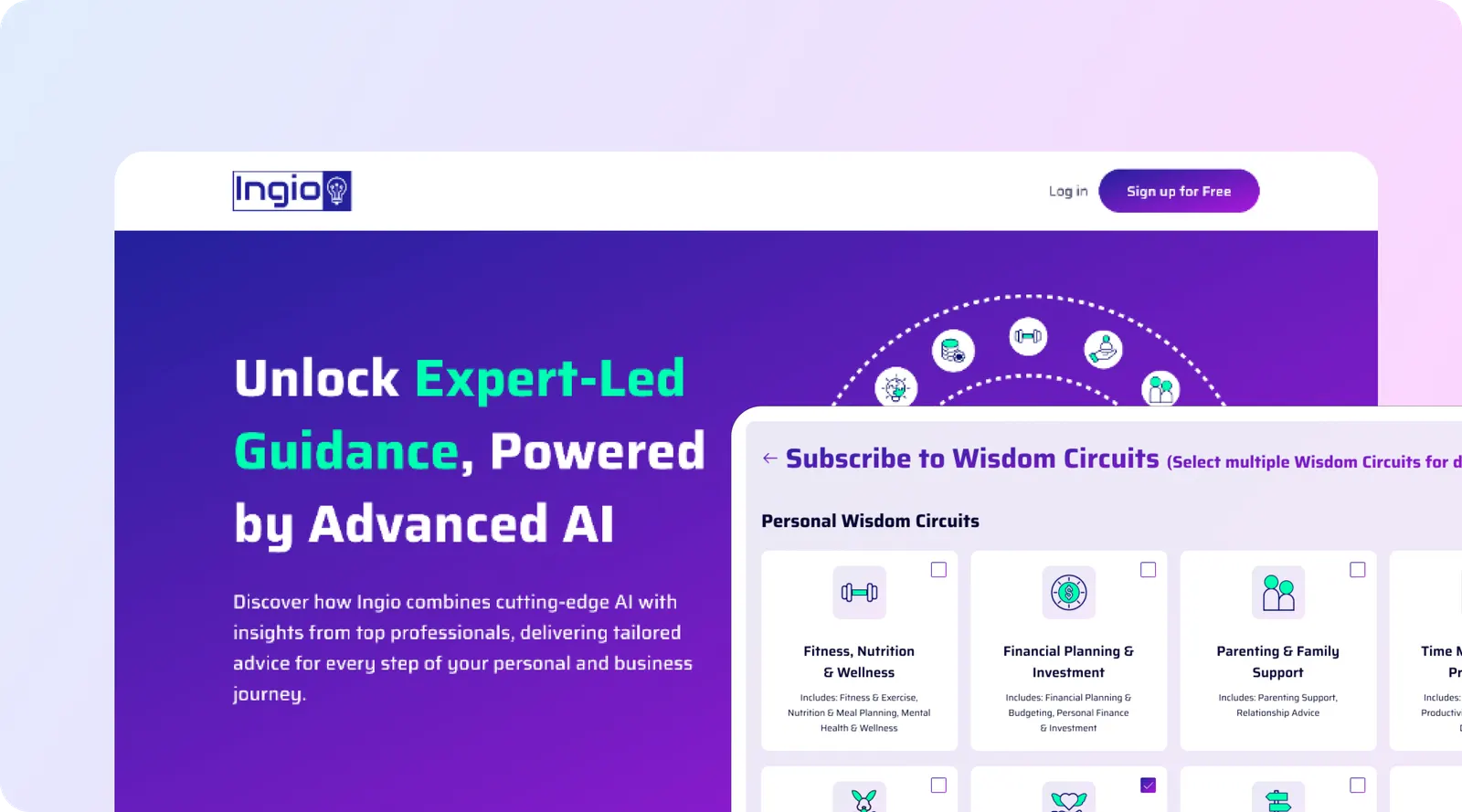
Ingio. Businesses had a scattering of AI assistants, each with its own copy of company knowledge, giving customers contradicting answers. We built a platform where every account has one shared knowledge layer and assistants are configurations on top of it (role, scope, tone, escalation rules), deployed to a web widget, Slack, email or API from one definition. It launched in 7 weeks; deploying an assistant now takes 20 minutes instead of six to eight weeks, and 3,400 business accounts signed up in the first year.
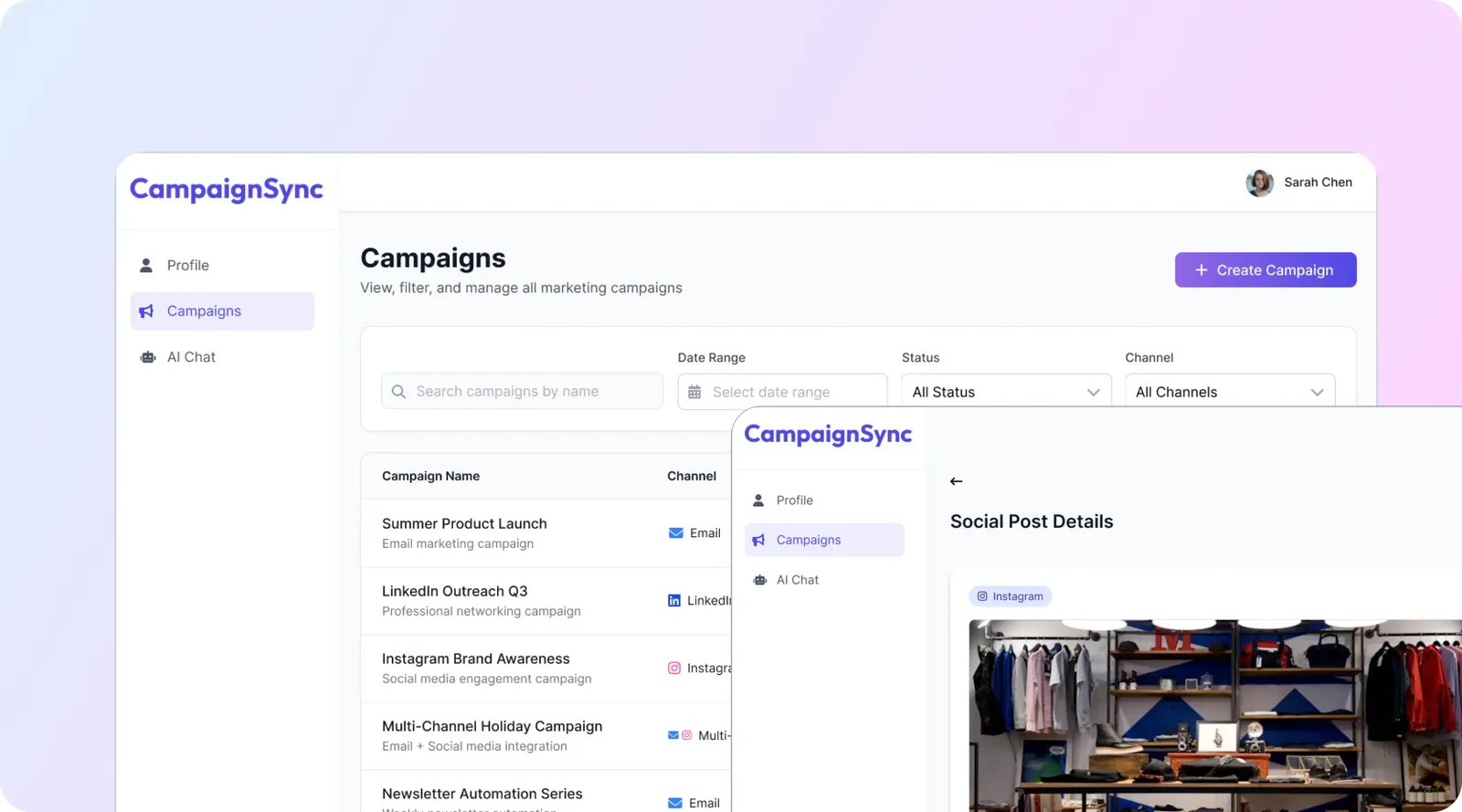
Campaign Sync. Marketing teams ran campaigns across disconnected tools, so messages drifted between channels and reporting took a day a week. One campaign definition now publishes to email and five social channels, with UTM templates enforced at creation and an approval step before publishing. Built in 7 weeks: posting consistency rose from 41% to 94% of planned content, and reporting assembly dropped from 9 hours a week to 20 minutes.
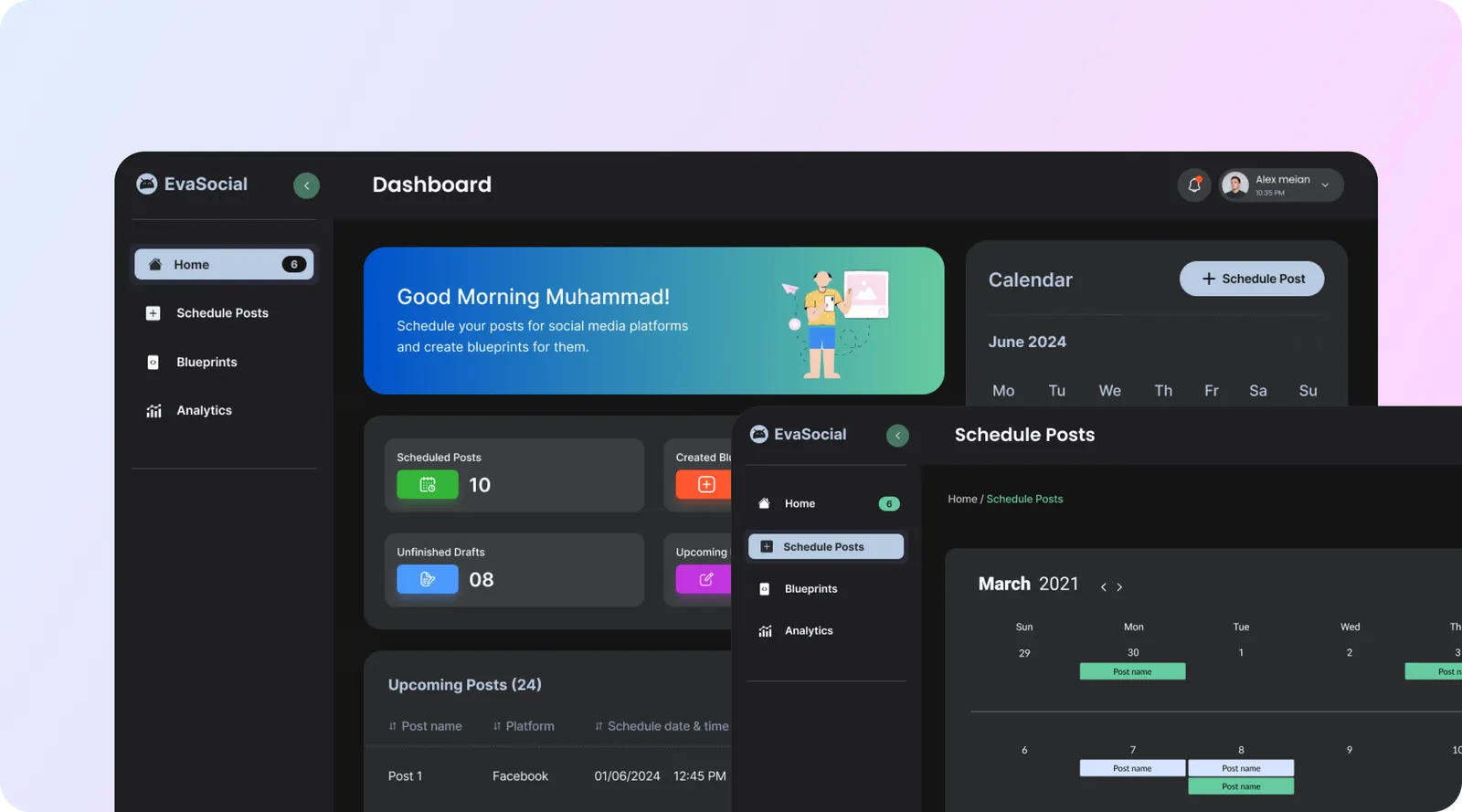
Eva Social. A self-serve SaaS for teams and solo creators: one brief becomes platform-native drafts for five formats, a calendar flags thin weeks, and an idea bank keeps the pipeline full. It reached 12,000 teams and creators within a year, and accounts moving to a maintained schedule saw engagement rise 37%.

DEMP Agency. An agency platform where each client brand has its own versioned brand system, and drafts are scored against it before review. Built in 6 weeks; revision rounds fell from 4.2 to 1.6 per deliverable and 28 client brands now run through it. Probado, our fifth SaaS example, is covered on our MVP development page.
Multi-tenant SaaS architecture: silo, pool or bridge?
Every SaaS product has to decide how separate each customer’s data and compute are. AWS’s SaaS Lens names three patterns (AWS Well-Architected SaaS Lens, checked Oct 31, 2026):
| Silo | Pool | Bridge | |
|---|---|---|---|
| What it means | Each tenant gets dedicated resources, such as its own database or full stack | Tenants share compute, storage and messaging | Some parts siloed, some pooled |
| Isolation | Strongest, by infrastructure | Enforced in code: tenant ID on every row, every query, every cache key | Per component |
| Running cost per customer | Highest | Lowest | In between |
| Releasing updates | Roll out to every tenant’s copy | One deployment for everyone | Mixed |
| Noisy neighbour risk | None between tenants | Needs rate limits and per-tenant quotas | Contained to pooled parts |
| Fits | Regulated or large enterprise customers who require dedicated infrastructure | Most new B2B and self-serve SaaS | Products with a mix of small and enterprise customers |
| Our usual choice | Only when a contract or regulation demands it | The default for a first version | Added when the first enterprise customer asks for a dedicated database |
AWS also points out that even a silo setup is still SaaS only if onboarding, identity and operations are shared; separate copies managed separately are a managed service, not SaaS.
What pooled isolation looks like in practice: every table that holds customer data carries a tenant ID; the tenant comes from the signed-in session, never from a URL parameter; database-level row security or a query layer enforces it, so one missed filter cannot leak data; file storage, caches, search indexes and background jobs are scoped the same way; and tests try to read another tenant’s data on purpose. Ingio is a good example of the pattern: every account has its own knowledge base and its own set of assistants on one shared platform.
SaaS billing with Stripe: what to build and what Stripe handles
Most of our SaaS builds use Stripe Billing for subscriptions. Stripe does the money side; the app has to stay in sync with it.
What Stripe handles. When you create a subscription, Stripe generates invoices, attempts collection and moves the subscription through its lifecycle. The documented statuses are trialing, active, incomplete, incomplete_expired, past_due, canceled, unpaid and paused. A subscription that needs immediate payment starts as incomplete; if the first invoice is not paid within 23 hours it becomes incomplete_expired (Stripe: how subscriptions work, checked Oct 31, 2026).
Failed payments. Stripe can retry failed renewals automatically. Its recommended Smart Retries setting is 8 tries within 2 weeks, and after the last retry you choose whether the subscription is canceled, marked unpaid, left past due or paused (Stripe: automate payment retries, checked Oct 31, 2026).
Self-service. Stripe’s hosted customer portal lets customers update billing details and tax IDs, change payment methods, change or cancel subscriptions, and view and pay invoices. Limits to know: customers can cancel but not change a subscription that has multiple products, usage-based prices or trial offers, plan switching is capped at 10 products, and the portal cannot be shown inside an iframe (Stripe: customer portal, checked Oct 31, 2026).
What the app has to build.
| Job | How we do it |
|---|---|
| Grant access | Provision features when the subscription is active or trialing, using Stripe entitlements or our own plan table |
| Stay in sync | A webhook endpoint that verifies Stripe signatures and handles invoice.paid, invoice.payment_failed, invoice.payment_action_required and subscription status changes; idempotent, so repeated events do no harm |
| Remove access | Restrict at unpaid or canceled, and show a clear “update your card” state during past_due |
| Plan limits | Seats, usage caps and feature flags enforced in the app as well as shown on the pricing page |
| Usage-based plans | Usage events reported to Stripe meters, with the same numbers shown to the customer |
| Revenue view | MRR, churn and failed-payment reports in the admin back office |
Pricing models Stripe supports. Flat rate (a tier at a fixed price), per-seat, tiered (unit price changes with volume or usage) and usage-based, including fixed fee plus overage, pay as you go and credit burndown (Stripe: recurring pricing models, checked Oct 31, 2026). Pick the model before the build: changing from flat to per-seat after launch touches billing, permissions and the pricing page at once.
What Stripe Billing costs. Stripe’s pricing page lists 0.7% of billing volume on the pay-as-you-go plan, covering recurring billing, automatic reminders, Smart Retries, up to three recovery automations and the customer portal (US$10 a month for a custom portal domain); payment processing is charged separately (Stripe Billing pricing, checked Oct 31, 2026). Real arithmetic: at $20,000 in monthly recurring revenue the Billing fee is $140 a month; at $100,000 it is $700. For marketplaces that pay out to sellers, Stripe Connect is the separate product we use, as on our GoHangars build.
How long does SaaS development take?
Your SaaS first version takes about 6 to 8 weeks with us: our SaaS builds launched in 6 (DEMP Agency), 7 (Ingio, Campaign Sync, Eva Social) and 8 weeks (Probado), and web apps across our 44-build timeline study have a median of 7 weeks. SaaS products with an AI feature at the core took 7 or 8 weeks, never 6, because model output needs testing on real inputs.
What adds weeks to your SaaS build:
- Integrations. A public API, webhooks for customers, or two-way syncs with the tools your customers use.
- Roles. Custom roles, approvals and fine-grained permissions inside each tenant account.
- Billing. Seats plus usage, proration, coupons or enterprise invoicing take longer than one flat plan with a trial.
- Live data. Real-time collaboration, live dashboards or usage metering need more testing.
- Compliance and enterprise needs. Single sign-on, audit logs, data residency or a dedicated database for one customer.
Each one you move to a later release takes time out of the first version. On the free call we set the launch scope with you and put a week-by-week plan in the written quote. The full data is in our app development timeline research.
How much does SaaS development cost?
SaaS cost comes from hours, and hours come from scope. The platform layers (tenancy, billing, admin) add a fixed amount of work on top of the features, which is why a SaaS first version usually costs more than a single-company internal tool with the same screens.
Our price. Our app and web app builds typically cost $7,000 to around $25,000 to $30,000, depending on features. A focused first version sits near the low end; many features, user roles, payments and integrations land near the top. We work project-based or hourly. After a free 30-minute call we send a written scope and quote, and you own the code at handover. Full details are on our pricing page.
| Cost driver | Lower cost | Higher cost |
|---|---|---|
| Tenancy | Pooled, one region | Silo or bridge, data residency in several regions |
| Roles | One or two roles per account | Complex permissions, approvals, custom roles |
| Billing | One flat plan with a trial | Seats plus usage, proration, coupons, invoicing for enterprise |
| Integrations | None or one | Several two-way syncs, public API and webhooks for customers |
| AI features | One hosted model call | Retrieval over each tenant’s data, evaluation, guardrails |
| Enterprise needs | Email login | Single sign-on, audit logs, security questionnaires, compliance work |
| Platforms | Web app | Web plus native mobile apps |
Running costs after launch need planning in a SaaS business in a way they are not for a one-off app: hosting that grows with tenants, email and SMS services, AI model usage if the product uses it, Stripe fees, and a maintenance and release plan (software maintenance and support).
How the quote works. After a free 30-minute call we send a written scope, a quote and a week-by-week plan, with the platform layers and the features priced together so nothing is a surprise. For a rough number before the call, estimate your build in two minutes.
How we build a SaaS product, step by step
We build your SaaS first version in seven phases, usually over about 7 weeks, and you receive something concrete at each one:
| When | Phase | What happens | What you receive |
|---|---|---|---|
| Before week 1 | Free 30-minute call, then written scope and quote | Who the paying customer is, the core workflow, the pricing model, the tenancy choice | A written scope, quote and week-by-week plan |
| Week 1 | Architecture | Data model with tenant boundaries (pooled by default), roles, billing plan design, integration list | The architecture and billing plan in writing |
| Weeks 1 to 2 | Design, approved before code | Sign-up and tenant onboarding flow (create account, invite team, first useful action), core screens, billing and settings screens, admin | A clickable prototype you approve before we write code |
| Weeks 2 to 6 | Build with weekly demos | Multi-tenancy and auth first, then Stripe billing (plans, trials, upgrades, failed payments), then the core product | A working demo every week on a staging link |
| Weeks 6 to 7 | Testing | Cross-tenant access tests, Stripe test-mode runs of trials, upgrades, failed payments and cancellations, onboarding run-throughs, load checks | Test results and a launch checklist |
| Week 7 | Launch | Production release, live Stripe keys, monitoring and alerts on | Your product live for paying customers |
| At launch and after | Handover and support | Recorded video walkthrough, written documentation, code, cloud and Stripe accounts in your name; then fixes, the features first customers ask for, pricing and onboarding tuning | Full ownership; support billed per hour |
Who we build SaaS for
- Founders launching a SaaS MVP. You need paying customers fast with an architecture that will not need a rewrite at 100 tenants. Start with our MVP development page.
- Agencies and service firms productising a process. DEMP Agency and Campaign Sync turned internal ways of working into software sold to many teams.
- Companies adding AI to a subscription product. Ingio and Eva Social are AI-first SaaS; see AI app development.
- Established SaaS teams that need an extra engineering team for a new module, a billing rebuild or a move from single-tenant copies to a pooled architecture (legacy software modernization).
How to choose a SaaS development company
A checklist we hold ourselves to:
- SaaS products with paying customers in their portfolio, with timelines and results rather than screenshots alone.
- A clear answer on tenant isolation: where the tenant ID comes from, how it is enforced, and how it is tested.
- Billing experience beyond checkout: failed payments, plan changes, proration, webhooks and access control.
- In-house engineers, and a chance to talk to the technical lead before signing.
- Your accounts from day one: code repository, cloud, Stripe and domain in your name.
- A written quote with a stated rule for scope changes.
- A plan for after launch, because a SaaS product is never finished.
Why aibrevo for SaaS development
- In-house engineering. A 16-person engineering team in San Francisco led by co-founder and CTO Shivam Pujara, plus 30+ specialists who work with us remotely.
- 200+ software projects delivered by our engineering team, including Spirit Airlines’ group booking platform and the Miami Dolphins’ premium suites.
- Published SaaS results with build times on every case study: Ingio, Campaign Sync, Eva Social, DEMP Agency and Probado.
- CRM built in. We also run CRM setup and integration, so your trials, customers and plan changes can flow into GoHighLevel, HubSpot, monday.com or Pipedrive for your sales and success teams.
We build SaaS products for founders and companies across the US, working remotely from San Francisco; see app development by state and city.
Planning a SaaS product? Book a free 30-minute call. Tell us who pays, what they get done in the product and how you want to charge. We come back with the tenancy and billing setup we would use, a week-by-week plan and a written quote.
Sources
All pages opened on Oct 31, 2026.
- aibrevo case studies: Ingio, Campaign Sync, Eva Social, DEMP Agency, Probado, GoHangars.
- AWS, Well-Architected SaaS Lens: silo, pool and bridge models.
- Stripe Docs, how subscriptions work, automate payment retries, customer portal, recurring pricing models.
- Stripe, Billing pricing: 0.7% of billing volume, pay-as-you-go.