
Software development
MVP Development Company: Launchable First Versions Built by Our In-House Team in 5 to 10 Weeks
Written scope and quote after the call. NDA on request. You own the code.
Quick answer
We are an MVP development company that builds the first launchable version of a product: real users, real data, real payments, not a clickable demo. Across the 44 builds in our published case studies, the first version shipped in 5 to 10 weeks, with a median of 7. Our in-house engineering team in San Francisco scopes the smallest product that can prove demand, builds it, and stays on for what comes next.
Builds like this
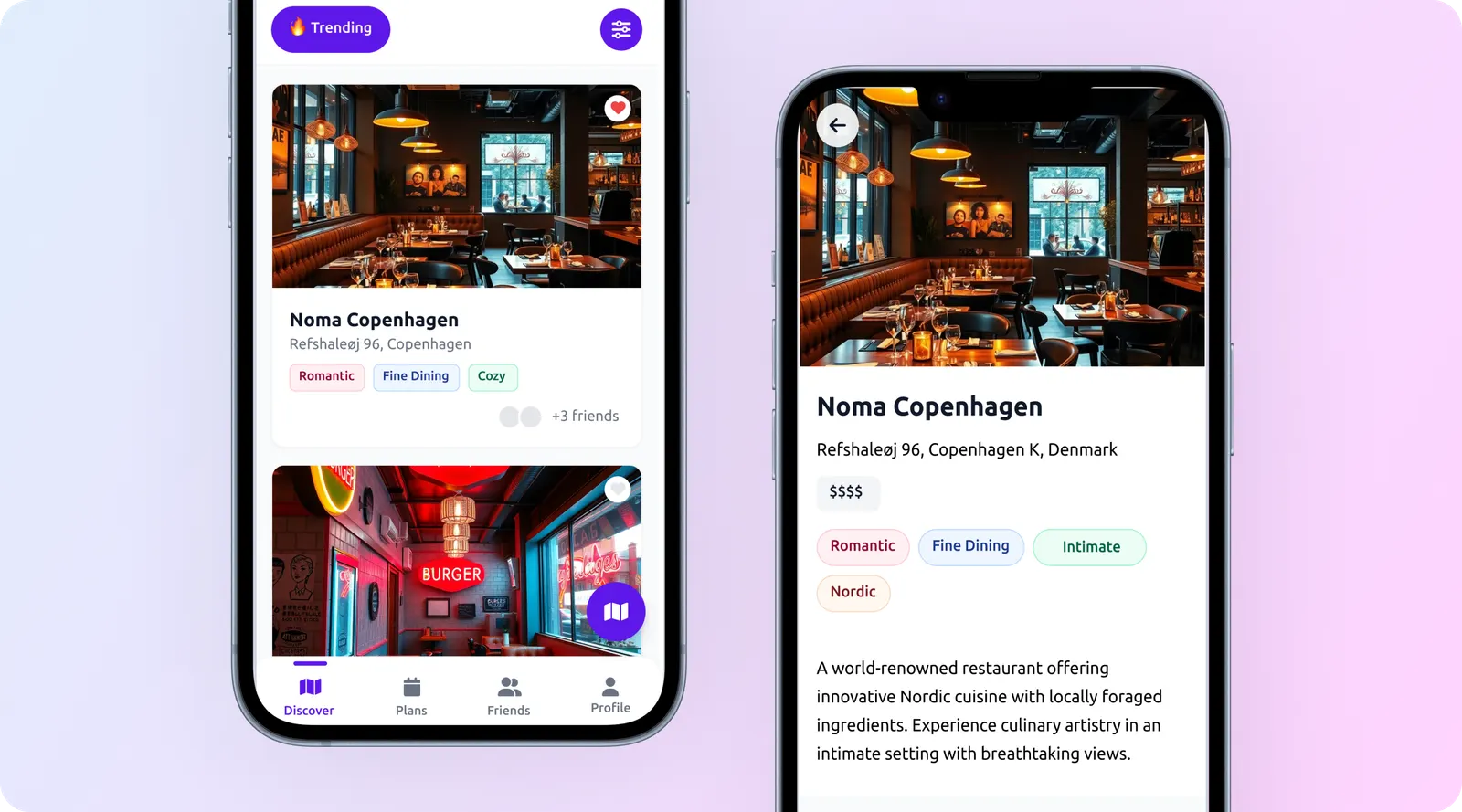

Part of the guide: Software development
Key takeaways
- Across the 44 builds in our published case studies, the first version shipped in 5 to 10 weeks; 40 of the 44 shipped in 8 weeks or less and the median was 7 weeks.
- An MVP is a working product real users pay for or rely on. A proof of concept answers 'can it be built', a prototype answers 'will people understand it', and only the MVP answers 'will people use it and pay'.
- Our app and web app builds typically cost $7,000 to around $25,000 to $30,000, depending on features, project-based or hourly, with a written quote after a free 30-minute call.
- Store costs are small next to build costs: the Apple Developer Program is US$99 a year and Google Play charges a US$25 one-time registration fee (both checked Oct 31, 2026).
- We quote every MVP in writing after a free 30-minute call, with a fixed scope and a week-by-week plan, and our app and web app builds typically cost $7,000 to around $25,000 to $30,000, depending on features, and we work project-based or hourly.
MVP development is building the first version of a product that real people can sign up for, use and pay for: the smallest thing that proves the idea works, shipped fast enough that you learn before the money runs out. We are an MVP development company with a 16-person in-house engineering team in San Francisco, and we build these first versions for founders, startups and companies testing a new product line. Across the 44 builds in our published case studies, the first version shipped in 5 to 10 weeks, with a median of 7. One of them, GoHangars, went from first call to a launched aviation storage marketplace in 7 weeks and closed a seed round nine months later. This page shows those timelines build by build, what drives MVP cost, and how we decide what goes into version one.
From the timeframe on each of our 44 published case studies, the My Rich Aunt case study and the Birdie case study.
How long does it take to build an MVP?
Most focused MVPs take 5 to 10 weeks of build once scope is agreed. That is not a sales number: it is the spread of the timeframes across our own published builds.
Here are six first versions that fit the classic MVP brief, a new product going to market for the first time, with the timeframe and the result each one reached:
| Product | What the first version did | Time to launch | Result after launch |
|---|---|---|---|
| My Rich Aunt | Student fundraising campaigns with verified student status | 6 weeks | $3.1M raised by students in 18 months; average campaign hits its goal in 19 days |
| Wingman Pilot | Marketplace matching aircraft owners with credential-checked pilots | 7 weeks | 8,900 verified pilots; 34,000 flights staffed |
| Alendil | Short-term rental marketplace with one all-in nightly price | 7 weeks | 2,900 properties and 34,000 nights booked in year one |
| Birdie | Turns saved social posts into a day-by-day trip itinerary | 8 weeks | 88,000 itineraries in year one; first draft in 40 seconds |
| Probado | Marketplace for unmoderated user testing with recorded sessions | 8 weeks | 2,900 startups in year one; test round from 3 weeks to 4 days |
| HirePrep | Adaptive investment banking interview training with mock interviews | 8 weeks | 18,000 candidates over two cycles; 240,000 mock sessions |
Timeframes and results from each linked case study.
What moves a build toward 5 weeks or toward 10: the number of user types (a two-sided marketplace has two onboarding flows), outside systems to connect, whether native mobile apps are needed on day one, and how fast decisions come back from the founder. The last one matters more than most people expect. A week waiting on feedback is a week added to the plan.
MVP vs prototype vs proof of concept: which do you need?
They answer different questions, so the right one depends on your biggest unknown.
| Proof of concept (POC) | Prototype | MVP | |
|---|---|---|---|
| Question it answers | Can this be built at all? | Do users understand the flow? | Will people use it, come back and pay? |
| What it is | A technical test, often a script or a narrow back end | Clickable screens, usually in Figma, with no real data | A working product with accounts, data and payments |
| Who sees it | The team | Test users and investors | Real customers |
| Typical time | Days to two weeks | One to three weeks | 5 to 10 weeks in our builds |
| What you have at the end | Confidence (or not) in the hard part | A tested design | A live product and usage data |
| Choose it when | The core technology is unproven | The idea is clear but the experience is not | You need evidence of demand |
The POC and prototype timing are general practice ranges, not measurements from our builds; the MVP row is our own data.
Many founders come to us with a prototype already done. GoHangars arrived with a Figma file and a 300-row spreadsheet of hangar operators after two earlier teams had not delivered; we agreed a seven-week scope to a launchable marketplace with real listings, not another prototype. When the hard part is technical, such as Birdie’s job of working out which restaurant a 15-second travel video is about, we prove that piece early inside the build rather than as a separate project.
What our MVP development services include
Everything needed to put a working product in front of real users, delivered by the same in-house team:
| Deliverable | What you get |
|---|---|
| Scope and plan | A one-page product scope: who the first user is, the one job the MVP must do, the feature list, and the written “after launch” list |
| UX and UI design | User flows and screens for every step of the core path, designed for mobile and desktop |
| Web app | A responsive web application, the default for most first versions |
| Mobile apps | iOS and Android apps when the product needs them on day one (see mobile app development) |
| Back end and database | APIs, data model, user accounts, roles and permissions |
| Payments | Subscriptions, one-off payments or marketplace payouts, usually through Stripe; GoHangars runs on Stripe Connect with automatic operator payouts |
| Admin tools | A back office to manage users, content and disputes without touching the database |
| Analytics | Event tracking on the core flow so you can see where users drop off from week one |
| CRM connection | Sign-ups and customers flowing into GoHighLevel, HubSpot, monday.com or Pipedrive |
| Launch | Hosting, domains, store submission if mobile, monitoring and error alerts |
| After launch | Fixes, measurement and the next round of features (maintenance and support) |
MVPs we have built
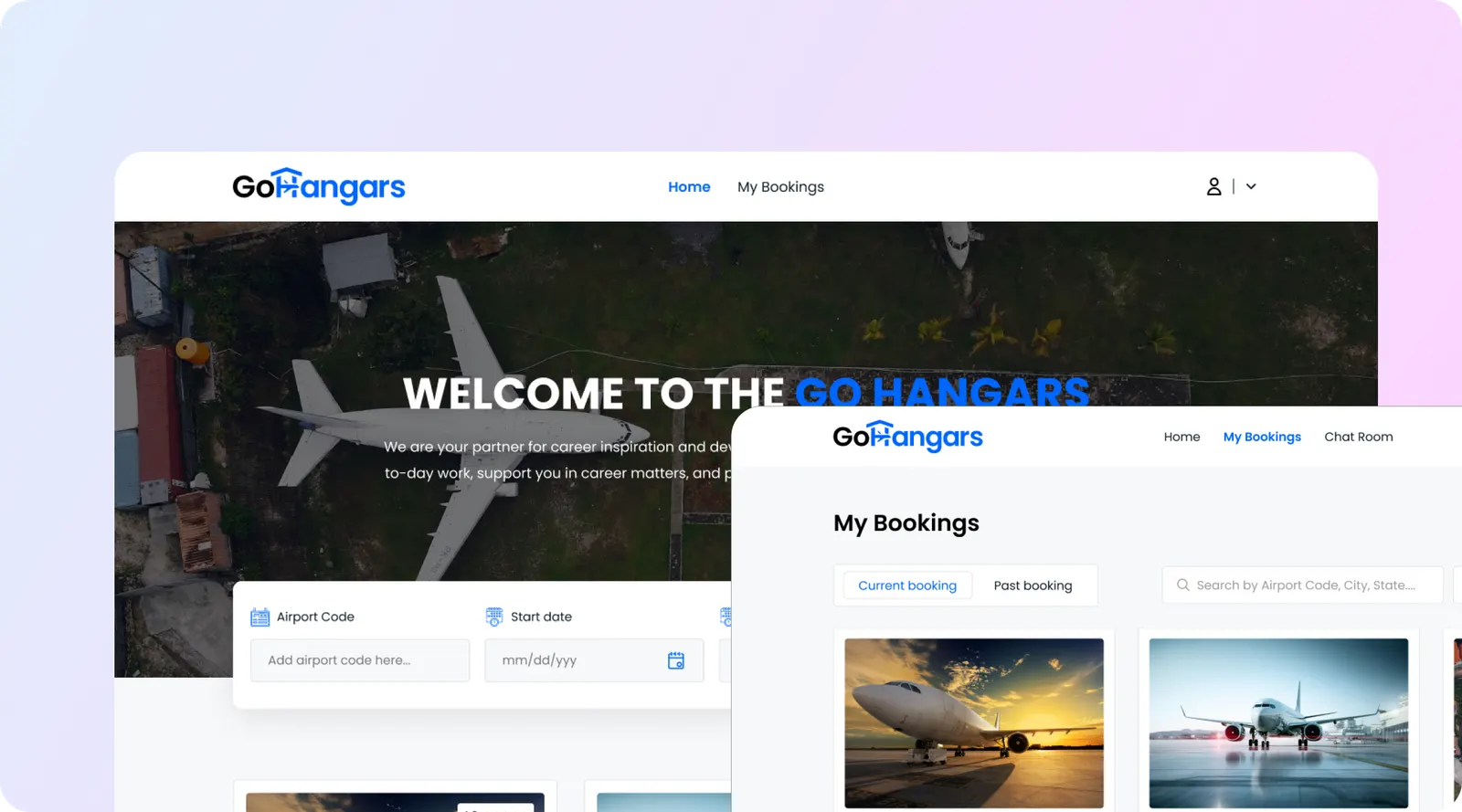
GoHangars. The founder had a spreadsheet of hangar operators he had phoned himself, and two failed attempts behind him. We built a two-sided marketplace searchable by airport code, with listings that capture door width, depth and power, and Stripe Connect payouts to operators. It shipped in 7 weeks, reached 1,240 listings across 38 states in six months and $2.1M in booking volume in year one, and the company closed a seed round nine months after launch.
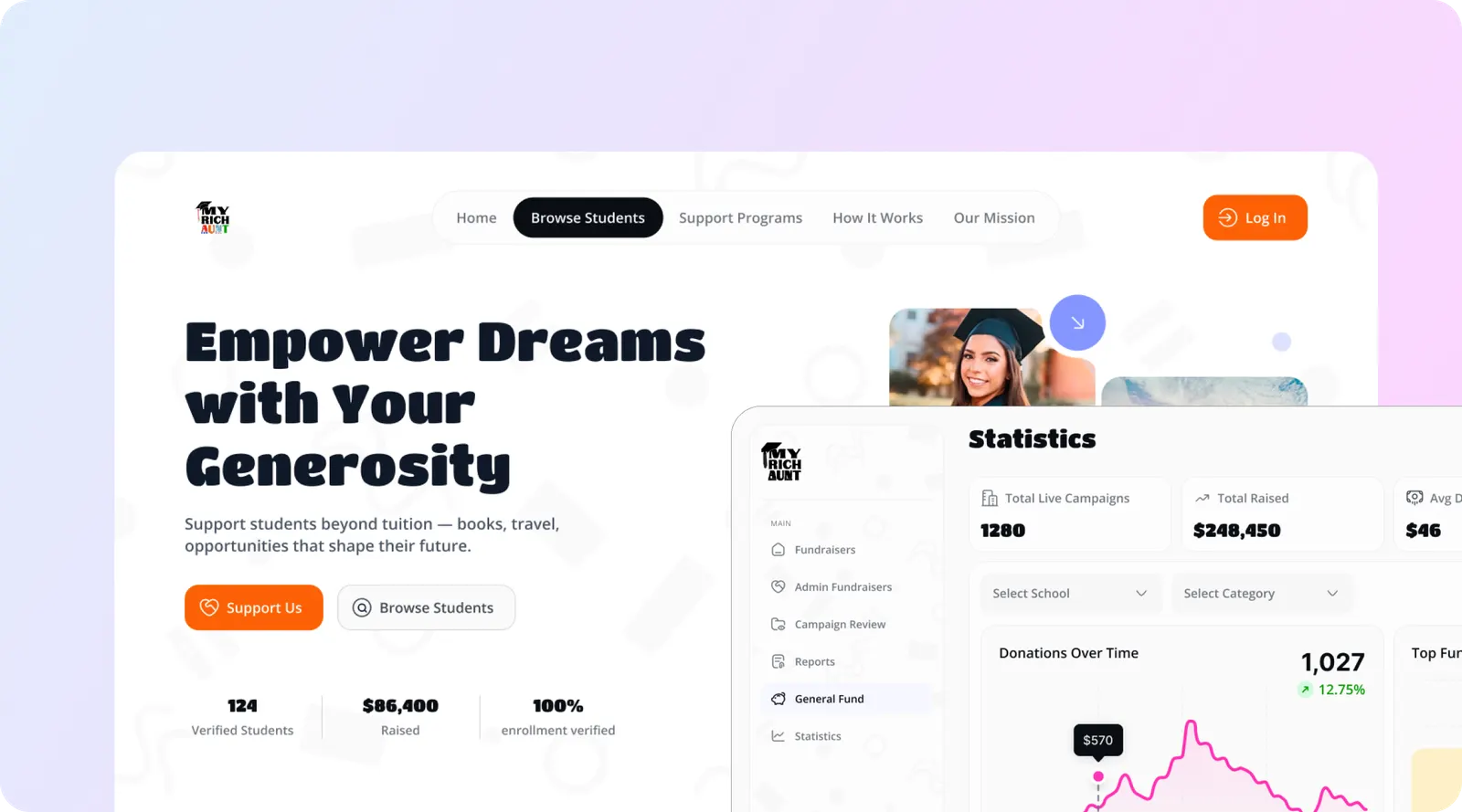
My Rich Aunt. Students raise money for costs that financial aid does not cover. The first version required every campaign to break down what the money is for and verified student status through an institutional email, which is what made small campaigns credible. It launched in 6 weeks; students raised $3.1M in the first 18 months, and 73% of donors are outside the student’s immediate family.
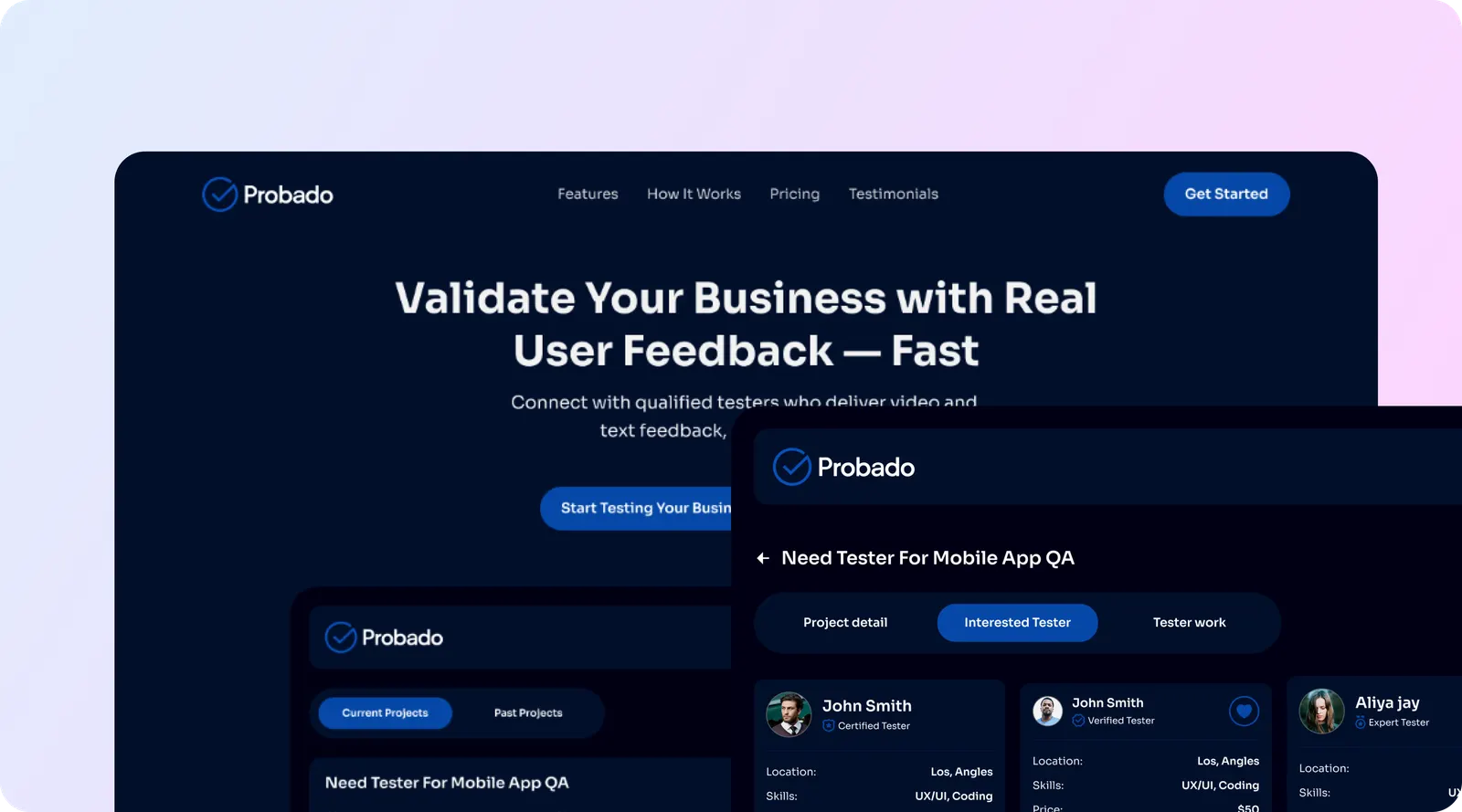
Probado. Early-stage teams skip user testing because a traditional round takes weeks and costs thousands. Probado’s first version recruited and screened testers, recorded unmoderated sessions and flagged the moments where users hesitated. It took 8 weeks to build; a full test round dropped from 3 weeks to 4 days and from $4,800 to $390, and 2,900 startups used it in the first year.

Wingman Pilot. Aircraft owners spent three to five days on calls to find a qualified pilot. The MVP matched on aircraft type first and blocked any pilot whose currency or medical had expired from accepting a flight. Built in 7 weeks, it now sources a pilot in 6 hours at median, with 34,000 flights staffed and zero currency or certification lapses on platform-booked flights.
More first versions: Birdie, Alendil, HirePrep, and the full list on our work page.
How we build an MVP, week by week
Our plan for a typical 7-week MVP. Shorter builds compress steps 2 and 3; longer ones add weeks to step 3.
| Week | Phase | What happens | What you approve |
|---|---|---|---|
| Before week 1 | Free call and quote | We hear the idea, ask who the first user is, and send a written scope and quote | The scope and the “after launch” list |
| 1 | Discovery and flows | User journeys for the core path, data model, risky parts identified | User flows |
| 1 to 2 | Design | Screens for each step, a clickable version to test with a few target users | Final designs |
| 2 to 6 | Build | Weekly releases to a staging link you can click through; the riskiest feature goes first | Each weekly release |
| 6 to 7 | QA and launch prep | Testing on real devices and browsers, payment tests, analytics events, store submission if mobile | Launch checklist |
| 7 | Launch | Production release, monitoring on, first users invited | Go-live |
| After launch | Measure and support | Bug fixes, usage review, next feature round | The next scope |
Scope changes are welcome but written down: a new feature either replaces something of similar size or moves to the next round. That rule is the main reason our timeframes hold.
How much does an MVP cost?
Our price. Our app and web app builds typically cost $7,000 to around $25,000 to $30,000, depending on features. A focused first version sits near the low end; many features, user roles, payments and integrations land near the top. We work project-based or hourly. After a free 30-minute call we send a written scope and quote, and you own the code at handover. Full details are on our pricing page.
What moves the number:
| Cost driver | Lower cost | Higher cost |
|---|---|---|
| User types | One (a single-sided tool) | Two or more (buyers and sellers, admins, partners) |
| Platforms | Responsive web app | Web plus native iOS and Android |
| Payments | Simple checkout or subscription | Marketplace payouts, escrow, refunds, tax |
| Integrations | None or one | Several outside systems, legacy data, airline or EHR-style APIs |
| AI features | None, or one call to a hosted model | Custom extraction, retrieval over your data, evaluation |
| Compliance | Standard privacy | HIPAA, financial or aviation records, audit logs |
| Design | Clean standard patterns | Custom brand system and motion |
Fixed running costs to plan for: hosting, email and SMS services, and the app stores if you go mobile. Apple’s Developer Program costs US$99 per membership year (Apple, checked Oct 31, 2026) and Google Play charges a US$25 one-time registration fee (Google Play Console Help, checked Oct 31, 2026).
How the quote works. After a free 30-minute call we send a written scope with a quote and a week-by-week plan. If the idea is too big for one round, we say so and split it. Want a first range before the call? Estimate your build in two minutes.
Which technology should an MVP use?
Pick the stack that ships the core flow fastest without boxing you in later. The choice that matters most is the delivery format, not the framework.
| Approach | Good for | Watch out for |
|---|---|---|
| No-code (Airtable, Bubble and similar) | Validating with a small group, internal tools, a few hundred users | Custom logic, performance, permissions, investor questions about code ownership |
| Responsive web app in code | Most MVPs: SaaS, marketplaces, portals, dashboards | Push notifications and device features are limited compared with native |
| Cross-platform mobile (one codebase for iOS and Android) | Consumer products that need app store presence and device features | Store review time and fees; some native features need extra work |
| Native iOS and Android | Heavy camera, location, offline or performance needs | Two codebases, the slowest and costliest first version |
| Our default | A responsive web app, adding mobile when usage proves the need | We change this when the product lives on the phone, as with Wingman Pilot’s pilots in the field |
Whatever the stack, three things should be true at launch: you own the code and accounts, the data model can grow without a rewrite, and analytics show what users actually do.
Who we build MVPs for
- Founders with a validated problem. You have talked to customers, maybe have a waitlist or a Figma prototype, and need a working product. GoHangars, My Rich Aunt and Wingman Pilot started here.
- Funded startups after a pivot or a failed first build. You need someone to rescue the scope and ship in weeks, not quarters.
- Established companies testing a new product line. You want a separate first version that does not touch the core system until it proves itself, then connects to your CRM.
- Non-technical founders. Our CTO-led team acts as your engineering function until you hire one, and hands over cleanly when you do.
Industries we have shipped first versions in include travel (Birdie, Alendil), aviation (GoHangars, Wingman Pilot), education (HirePrep, My Rich Aunt) and SaaS (Probado).
How to choose an MVP development company
A short checklist. We hold ourselves to every line.
- Shipped first versions with timelines. Ask for products that launched, how long each took and what happened next. Our timeframes are on every case study.
- In-house engineers. Find out who writes the code. Subcontracted teams make timelines harder to keep.
- Code and account ownership in your name from day one: repository, cloud, domain, stores.
- A written quote with a written scope, and a stated rule for how changes are handled.
- Weekly working releases you can click, not status reports.
- Someone who will tell you to cut features. If every idea makes it into version one, it is not an MVP.
- A plan for after launch: who fixes bugs, who builds round two, and what that costs.
- Talk to the technical lead, as well as sales, before you sign.
Why work with aibrevo on your MVP
- In-house engineering. A 16-person engineering team in San Francisco led by co-founder and CTO Shivam Pujara, plus 30+ specialists who work with us remotely.
- 200+ software projects delivered by our engineering team, including Spirit Airlines, the Miami Dolphins, Life Line Ambulances and DAIN.
- Published timelines. 44 case studies, each with its build time, so you can check our 5 to 10 week range for yourself.
- CRM built in. Because we also run CRM setup and integration, your MVP’s sign-ups and customers can flow straight into GoHighLevel, HubSpot, monday.com or Pipedrive from launch day.
- We stay after launch. The team that built version one builds version two.
We build MVPs for founders across the US remotely from San Francisco; see app development by state and city.
Have an idea that needs a first version? Book a free 30-minute call. Tell us who the first user is and the one thing they need to get done. We come back with a written scope, a week-by-week plan and a quote, and we will tell you what to leave out of version one.
Sources
All pages opened on Oct 31, 2026.
- aibrevo case studies: timeframe and impact fields on all 44 published builds at /work/.
- Apple Developer, enrollment: US$99 per membership year.
- Google Play Console Help, developer account registration: US$25 one-time fee.