
Software development
Marketplace App Development: Two-Sided Marketplaces Built by Our In-House Team
Written scope and quote after the call. NDA on request. You own the code.
Quick answer
Marketplace app development is building the platform where two groups, buyers and sellers, owners and providers, bookers and talent, find each other, agree terms and pay. Our in-house engineering team has shipped nine marketplaces in 6 to 8 weeks each, from hangar storage to home services, with verification, structured quotes, held payments and payouts built in. This page shows those builds, how marketplace payments work on Stripe Connect, what drives cost, and how we scope one.
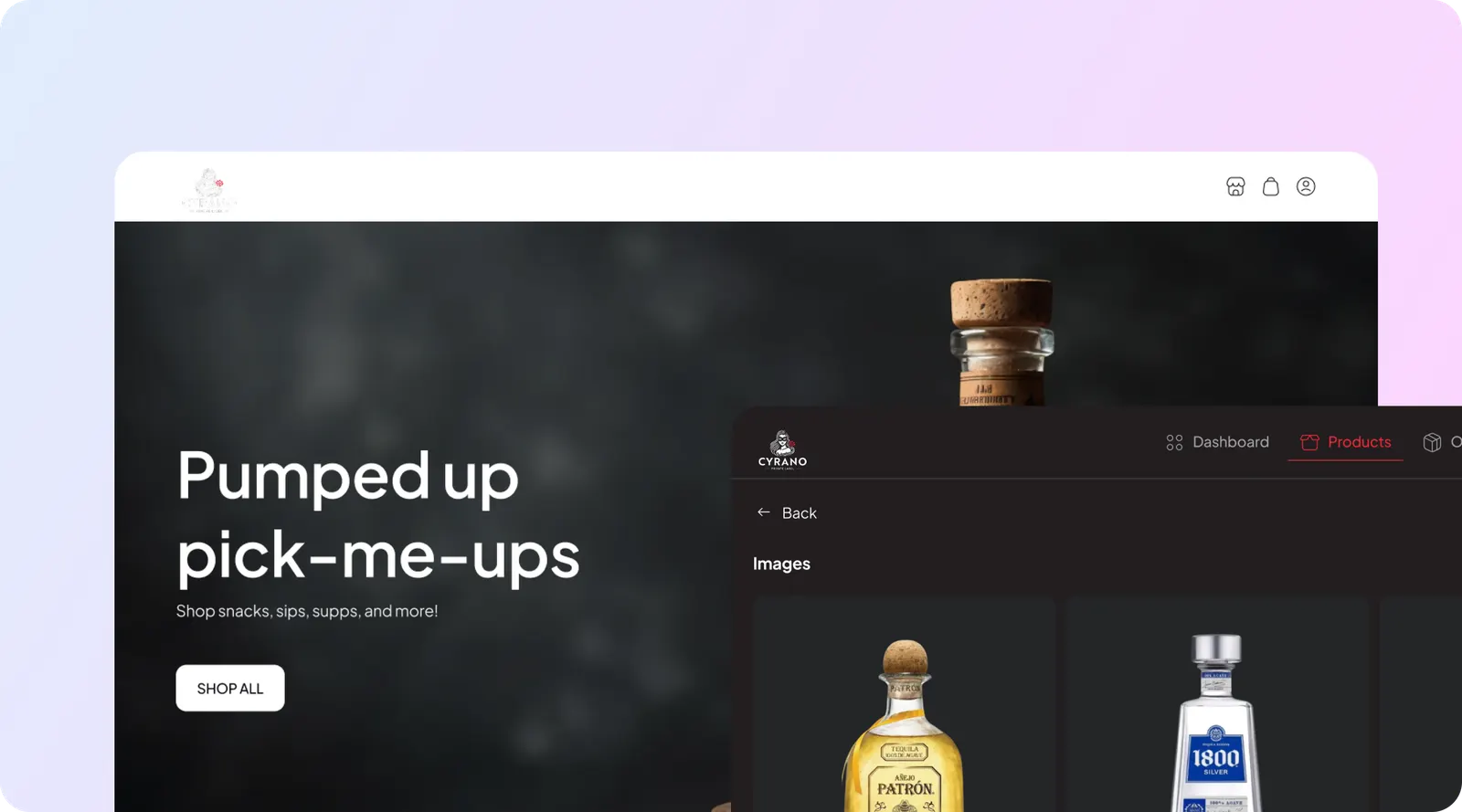
Builds like this
Part of the guide: Software development
Key takeaways
- Our team has built nine two-sided marketplaces (Hago, GoHangars, Simply Bids, Alendil, Load Management, Wingman Pilot, Infuse CTL, Farmers Market Haul, Coo), each in 6 to 8 weeks.
- The hard part of a marketplace is trust, not search: verification of the supply side, comparable quotes, payment held until the job is done, and reviews tied to completed transactions.
- Stripe Connect offers three charge types. Stripe names destination charges as best suited for marketplaces like home rentals, and separate charges and transfers for splitting one payment across several sellers (checked Oct 31, 2026).
- Stripe does not provide escrow. Marketplaces hold funds with manual payouts instead, which must be paid out within 2 years for US businesses and 90 days in most other countries.
- Our app and web app builds typically cost $7,000 to around $25,000 to $30,000, depending on features, and we work project-based or hourly. Each marketplace is scoped and quoted in writing after a free 30-minute call.
Marketplace app development is building the platform where two groups transact through you: homeowners and contractors, aircraft owners and hangar operators, bookers and performers. A listings page is the easy part. The work is in the rules that make strangers trust each other: verifying the supply side, making quotes comparable, holding payment until the job is done, splitting each payment between seller and platform, and tying reviews to completed transactions. Our in-house engineering team has built nine two-sided marketplaces, each in 6 to 8 weeks from the first call to a launchable product with real listings. GoHangars, for example, reached 1,240 hangar listings across 38 states in its first six months and $2.1M in booking volume in year one. This page shows those builds, how marketplace payments work, what drives cost, and how we scope one.
From our Hago, Simply Bids and GoHangars case studies.
Which marketplaces have we built?
Nine, across services, rentals, talent, healthcare and local commerce. Every one is two-sided, and every one was built in 6 to 8 weeks.
| Marketplace | Type | The two sides | Timeframe | Headline result |
|---|---|---|---|---|
| Hago | Home services | Homeowners and vetted local providers | 8 weeks | Quote turnaround from 3 days to 90 minutes; 140,000 jobs in year one |
| GoHangars | Aviation storage booking | Aircraft owners and hangar operators | 7 weeks | 1,240 listings in 38 states in six months; $2.1M booked in year one |
| Simply Bids | Bidding (landscaping) | Homeowners and contractors | 7 weeks | 4 comparable quotes in 48 hours; contractor win rate 31% vs about 8% on lead services |
| Alendil | Short-term rentals | Travellers and property hosts | 7 weeks | 2,900 properties; checkout abandonment 12%; 71% rebook within a year |
| Load Management | Talent booking | Bookers and artists | 6 weeks | Shortlist from 9 days to under 4 hours; payment within 48 hours of performance |
| Wingman Pilot | Pilot hiring | Aircraft owners and contract pilots | 7 weeks | Pilot sourced in 6 hours at median; 34,000 flights staffed |
| Infuse CTL | In-home healthcare | Patients and licensed clinicians | 7 weeks | Booking to appointment in 4 hours at median; clinician utilisation 52% to 79% |
| Farmers Market Haul | Local food | Shoppers and market vendors | 6 weeks | 410 markets and 6,200 vendors; vendor sales up 22% with live stock lists |
| Coo | Local deals | Shoppers and local merchants | 6 weeks | 2,100 businesses in four cities; 310,000 deals redeemed in year one |
From the linked case studies. Timeframe is first call to a launchable product.
The pattern across the nine: none of them won on search. They won on a rule the incumbents did not enforce. Hago charges for completed jobs, not leads. Simply Bids makes every contractor bid against the same written scope. Wingman Pilot blocks a pilot with lapsed currency or medical from accepting a flight. Alendil ranks on total stay cost, not the nightly headline. That rule is usually the reason to build custom.
What do we build in a marketplace?
A marketplace is really three products: one for each side and one for you.
| Part | What it covers | Example from our builds |
|---|---|---|
| Supply onboarding and verification | Signup, licence, insurance and credential checks, re-checks on expiry | Hago verifies licence and insurance at signup and again on expiry; Wingman tracks ratings, medical and type currency |
| Listings with matching fields | The data that decides whether a match is possible | GoHangars captures door width, height and depth, and filters against each owner’s wingspan and tail height |
| Search and matching | Filters, map and radius, routing a request to a few matched providers | Hago routes a job to a small number of matched providers instead of broadcasting it |
| Quote, booking or bid | Calendars, structured quotes, change orders, contracts | Simply Bids: line-item bids against one scope, side by side, with in-platform change orders |
| Payments and payouts | Platform fee, seller payouts, held funds, refunds | GoHangars runs on Stripe Connect with automatic operator payouts and platform fee handling |
| Trust after the transaction | Reviews tied to paid jobs, completion sign-off, disputes | Hago reviews only from completed, paid jobs; Simply Bids completion sign-off with photos |
| Admin console | Approvals, disputes, refunds, reporting, content | Operator and market dashboards on GoHangars and Farmers Market Haul |
| Integrations | CRM, calendars, email and SMS, accounting | iCal sync on Alendil; CRM sync into GoHighLevel, HubSpot, monday.com or Pipedrive when you sell to the supply side |
Case studies: marketplaces our team built
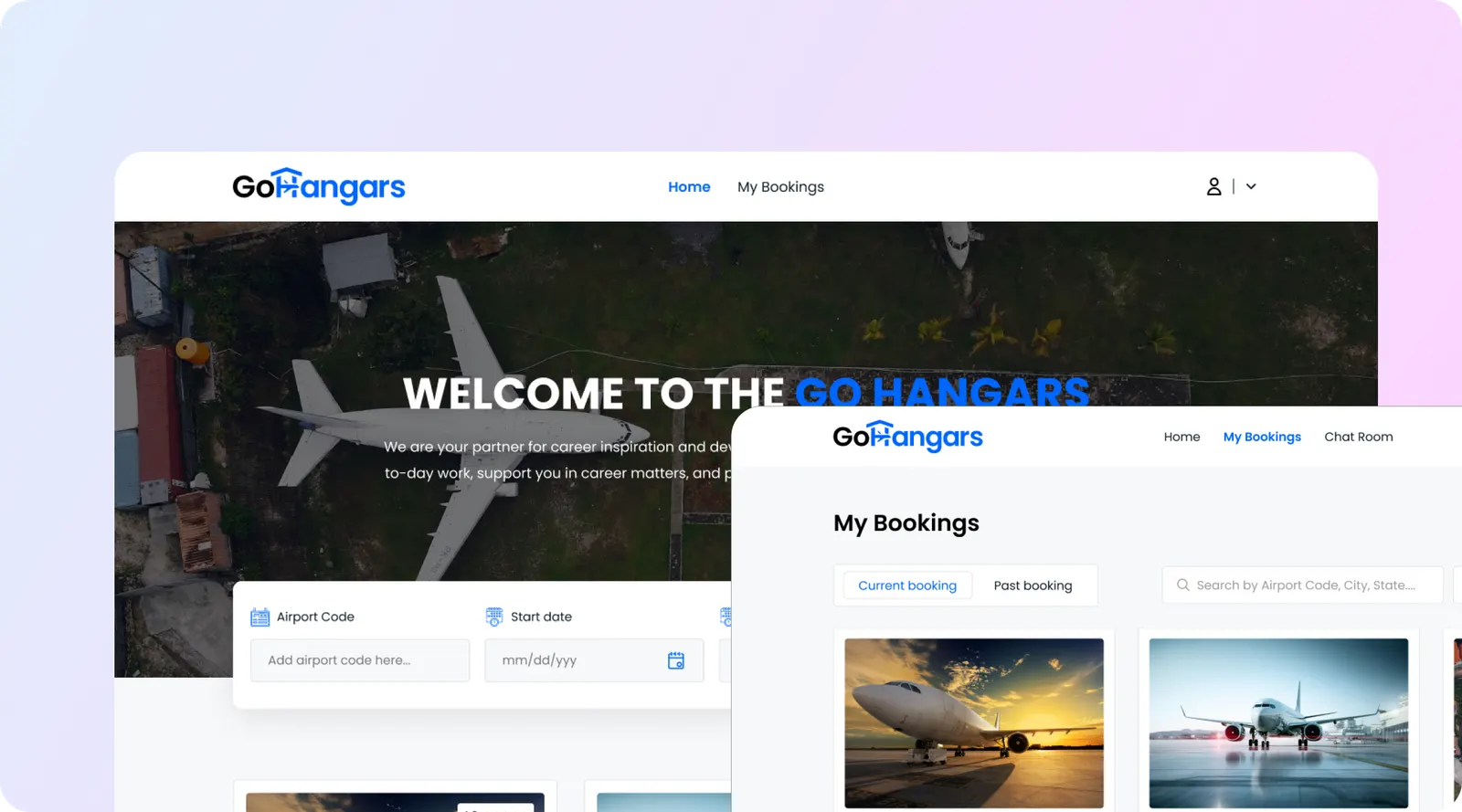
GoHangars. The founder arrived with a spreadsheet of 300 hangar operators he had phoned himself, and two failed attempts with other teams behind him. We agreed a seven-week scope to a launchable marketplace with real listings. Owners search by airport identifier, listings filter against each aircraft’s dimensions so nobody books a bay their aircraft cannot enter, insurance certificates are verified before confirmation, and payments run on Stripe Connect. Result: 1,240 listings across 38 states in six months, owner search time from three weeks of calls to same-day booking, and operator occupancy from 61% to 83%.
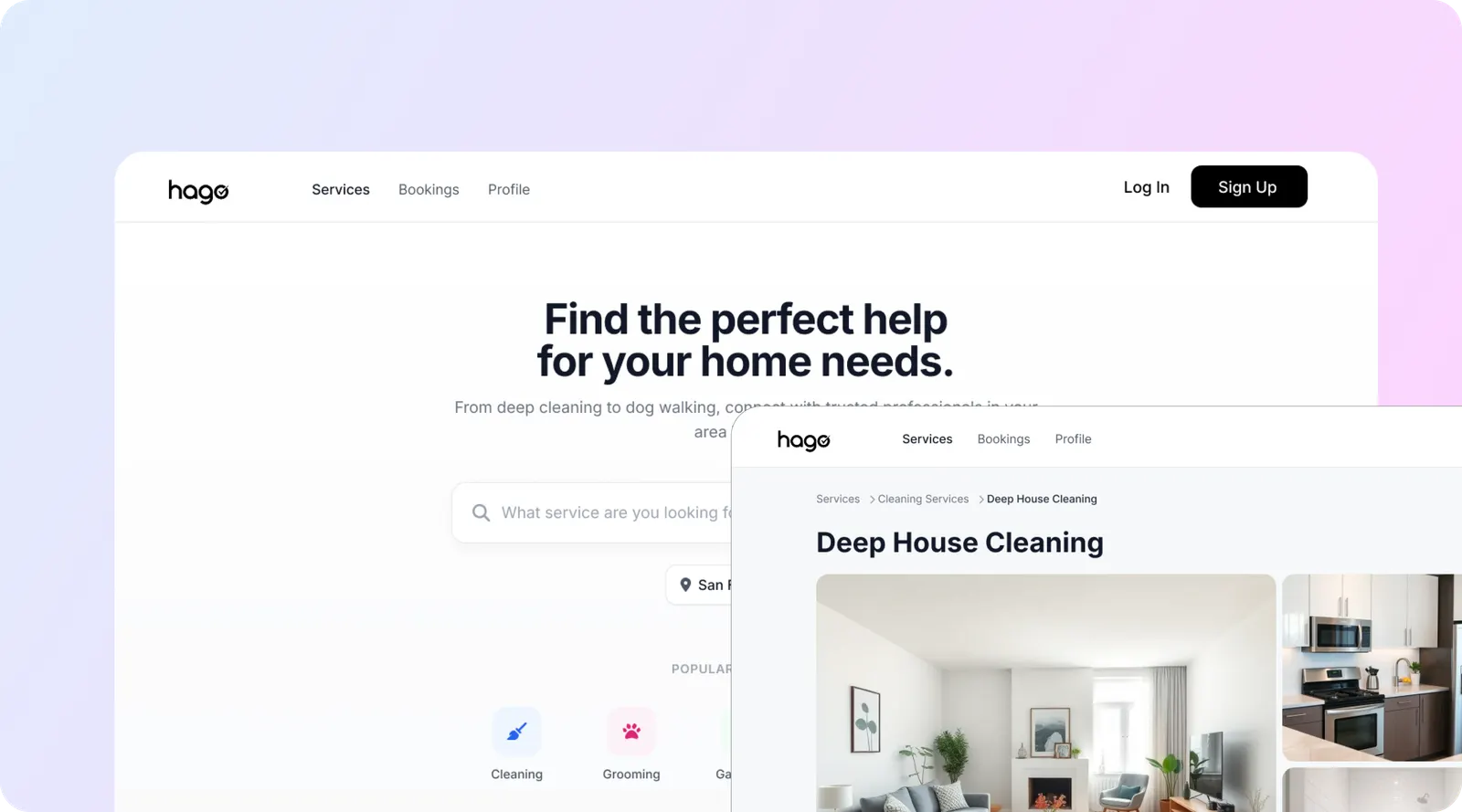
Hago. Lead platforms sold the same enquiry to five providers. Hago charges for a completed job instead. Providers are verified at signup and on expiry, quotes are itemised and accepted by both sides before work starts, and payment is held until the customer confirms completion. Result: 11,000 vetted providers in 22 categories, quote turnaround from 3 days to 90 minutes, and a 96% job completion rate.
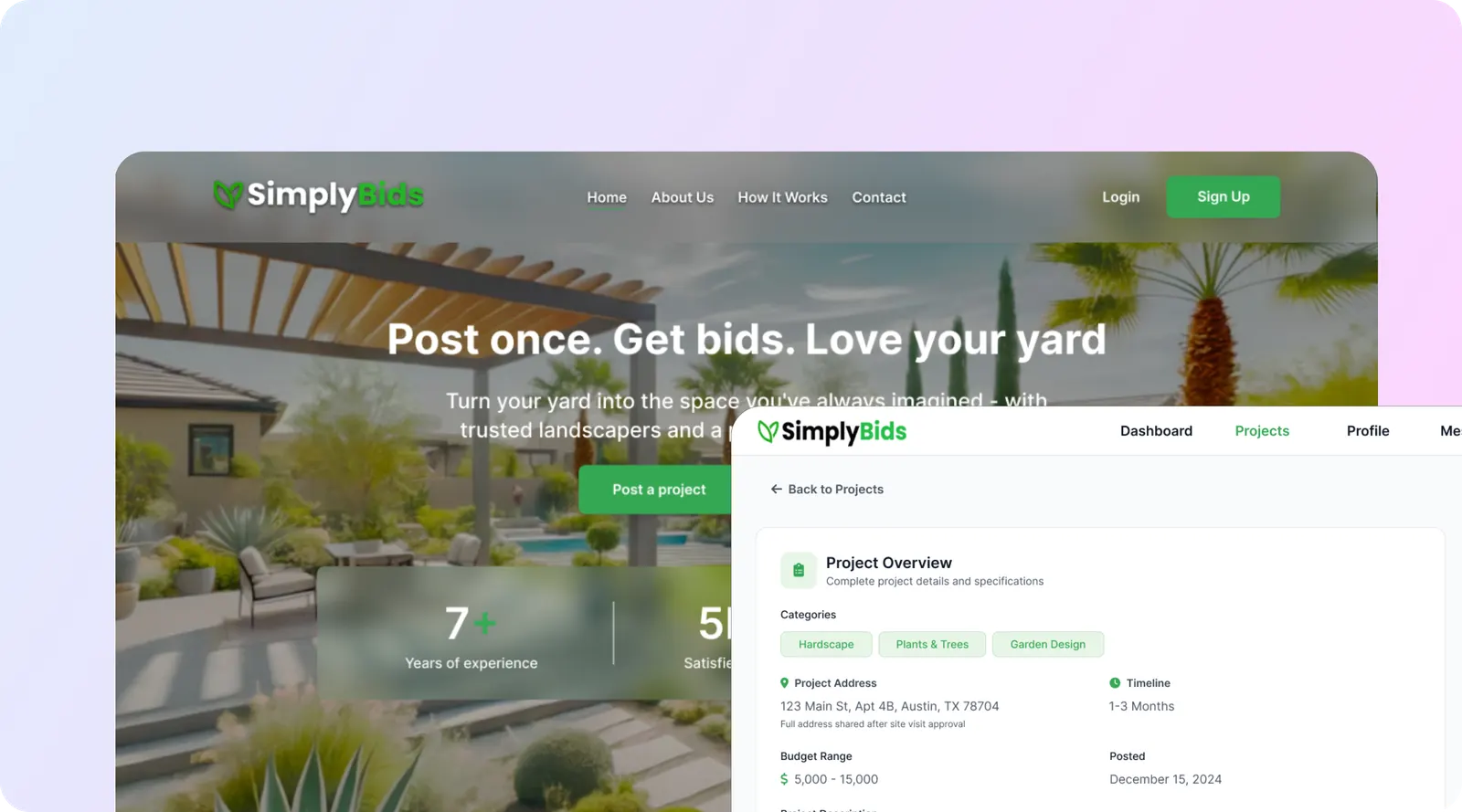
Simply Bids. Homeowners could not compare landscaping quotes because each contractor quoted different work. A guided brief now defines the scope first, contractors bid line by line against it and must state exclusions, and bids sit side by side with the differences highlighted. Result: 4 comparable quotes in 48 hours, 4,700 contractors bidding, and $41M in project value in year one.
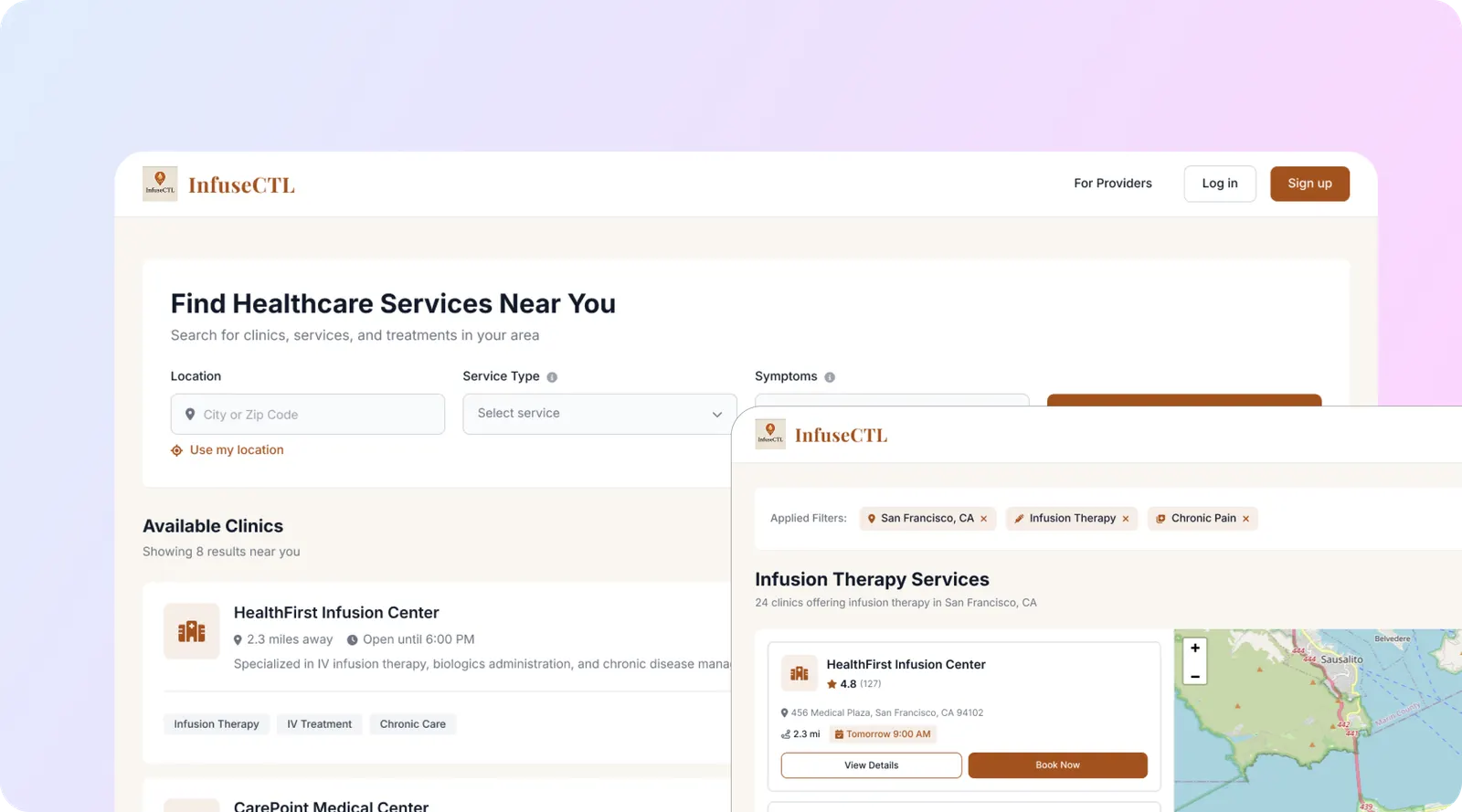
Infuse CTL. In-home treatment was booked by phone, shared calendar and group chat. We built route-aware scheduling that accounts for travel time, licence state and certifications, with intake and screening before confirmation. Result: booking to appointment in 4 hours at median (from three to five days), clinician utilisation from 52% to 79%, and cancellations down from 24% to 7%.
How do marketplace payments work on Stripe Connect?
Stripe Connect is Stripe’s product for multi-party businesses: each seller gets a connected account, the customer pays, and funds are split between the seller, your platform fee and Stripe’s fees. The charge type you choose decides whose balance takes the payment, who absorbs refunds and chargebacks, and whose name appears on the card statement (Stripe Connect charges, checked Oct 31, 2026).
| Charge type | How money moves | Refunds and disputes hit | Stripe’s own example | Fits |
|---|---|---|---|---|
| Direct charges | Charge is created on the seller’s connected account; your application fee moves to your balance | The seller’s balance | E-commerce platform for independent sellers, SaaS such as invoicing | Sellers who own the customer relationship (storefront builders, booking software) |
| Destination charges | Charge is created on your platform; part of the funds transfers to one seller immediately | Your platform balance (you can reverse the transfer) | Rideshare, a site matching contractors with homeowners; Stripe calls it best suited for marketplaces such as home rentals | Most service and rental marketplaces with one seller per order |
| Separate charges and transfers | Charge on your platform; you create transfers later, to one or several sellers | Your platform balance | A single cart from several businesses; a delivery split between store and courier | Multi-seller carts, assigning the provider after payment, splitting one payment |
| Our default | Destination charges for one-seller orders; separate charges and transfers only when one payment must reach several parties |
Source: Stripe docs, how charges work in Connect, checked Oct 31, 2026.
Three Stripe facts that change a marketplace design:
- There is no escrow. Stripe states that it does not provide escrow services or support escrow accounts. To hold a seller’s money until a job is confirmed, the platform sets that account to manual payouts and releases funds later. The holding limit depends on the business’s country: 2 years in the United States, 10 days in Thailand, 90 days elsewhere (manual payouts, checked Oct 31, 2026). When our case studies say payment is held until completion, this is the mechanism; a legally regulated escrow needs a licensed provider.
- Payout timing. By default connected accounts are paid out on a daily rolling basis. Standard payouts typically arrive 1 to 2 working days after submission, and instant payouts typically within 30 minutes (connected account payouts, checked Oct 31, 2026). Load Management’s promise to pay artists within 48 hours of a performance is built on this.
- Who sets pricing. On Stripe’s Connect pricing page, the “Stripe handles pricing” option charges the platform no Connect fees, while “You handle pricing” adds a fee per monthly active account, a fee per payout and a funds-routing fee, in exchange for setting your own processing prices (Stripe Connect pricing, checked Oct 31, 2026; the amounts differ by country, so read the page for yours).
How does a marketplace build work, week by week?
Our nine marketplaces ran 6 to 8 weeks. In our timeline study of 44 builds, the 16 builds with a marketplace side had a median of 7 weeks and a mean of 6.8. A typical 7-week build looks like this:
| Week | Stage | What happens |
|---|---|---|
| 1 | Discovery | The one rule the marketplace enforces, both user journeys, the payment flow (charge type, fee, hold), verification rules, launch market |
| 1 to 2 | Design | Clickable flows for each side and the admin console, listing fields, quote or booking screens |
| 2 to 6 | Development | Onboarding and verification, listings and search, booking or bidding, Stripe Connect payments and payouts, messaging, reviews, admin |
| 6 to 7 | QA and pilot | Test payments in Stripe test mode, refund and dispute paths, real listings loaded with the first suppliers |
| 7 | Launch | Production payments live, monitoring, first transactions watched end to end |
| After | Support | Fixes, the next segment (GoHangars added transient bookings; Alendil is adding month-plus stays) |
Week 6 to 7 is where most marketplaces fail if it is skipped: a refund that reverses the wrong transfer, a payout to an unverified account, a booking that double-books a calendar. We test those paths before launch, not after the first complaint.
What is included in a marketplace app development build?
You get a launch-ready marketplace for both sides plus your admin console, with payments tested end to end and everything handed over in your name. Your build includes:
- A written scope naming both user journeys, the matching rule, the payment flow and the launch market, agreed before code starts.
- Clickable designs for the supply side, the demand side and the admin console, approved before development.
- Onboarding and verification for the supply side, with the checks named in the scope.
- Listings, search and matching built around the fields that decide a match.
- Booking, quoting or bidding, whichever your transaction needs.
- Stripe Connect payments and payouts set up on a platform account in your name, with refund paths tested in test mode before launch.
- Messaging, reviews and the admin console for approvals, disputes, refunds and reporting.
- A staging link you can click through every week or two during the build.
- Launch support: production payments live, monitoring on, and the first transactions watched end to end.
- Handover: the code in your repository, a recorded video walkthrough and written documentation.
Not included: Stripe processing and Connect fees, hosting bills, third-party verification services, other software subscriptions and app store fees, which you pay to those vendors directly. Support after launch is billed per hour.
What does marketplace app development cost?
Cost follows the number of rules, not the number of screens. These are the drivers we scope:
| Cost driver | Lower effort | Higher effort |
|---|---|---|
| User roles | Two sides plus admin | Extra roles (market operators, agencies, clinics with staff) |
| Matching | Category and location filters | Hard constraints (aircraft dimensions, licence by state, route-aware scheduling) |
| Transaction | Fixed-price booking | Bids, itemised quotes, change orders, contracts |
| Payments | One seller per order, destination charges | Split payments across several parties, held funds, milestone releases |
| Verification | Email and ID | Licences, insurance, certifications with expiry monitoring |
| Platforms | Responsive web app | Native iOS and Android apps for one or both sides |
| Compliance | Standard consumer data | Health data (Infuse CTL ran under HIPAA-aligned controls), regulated money movement |
Our price. Our app and web app builds typically cost $7,000 to around $25,000 to $30,000, depending on features. A focused first version sits near the low end; many features, user roles, payments and integrations land near the top. We work project-based or hourly. After a free 30-minute call we send a written scope and quote, and you own the code at handover. Full details are on our pricing page. On that call we scope your marketplace and send a written quote with the launch week. Stripe’s processing and Connect fees, hosting and third-party verification services are separate running costs, and we list them in the quote. Want a first range before the call? Estimate your build in two minutes.
Custom build, marketplace builder or white-label?
| Option | Best when | Limits |
|---|---|---|
| Marketplace builder (SaaS) | Standard listings, checkout and reviews; testing demand before paying for code | Hard to add custom matching, bidding or credential rules; you rent the platform |
| White-label marketplace | A known model (food delivery, rentals) with your brand on it | Logic is the vendor’s; switching later means rebuilding |
| Custom build | The rule that makes your marketplace work is not a standard feature | Higher up-front cost; you own the code and the data |
| Verdict | Validate on a builder if your model is standard. Build custom once the core rule is the product, which was true of all nine of ours. |
Web or app first? For most MVPs we ship a responsive web app for both sides, then a native app for the side that works on the move. Farmers Market Haul vendors post a week’s stock in under 2 minutes from a phone at the stall, so supply needed mobile from day one; buyers comparing hangars or contractors were fine on the web. See mobile app development for the native versus cross-platform choice.
Who do we build marketplaces for?
- Founders launching a marketplace MVP. Six of our nine marketplaces started from a founder who had worked the problem by hand: running an FBO, a market stall, a landscaping business, a booking desk. Our MVP development page covers the scoping.
- Operating businesses opening a second side. A service company that wants to route overflow jobs to vetted partners, or a clinic network adding independent clinicians.
- Industries we have shipped in: home services (Hago, Simply Bids), aviation (GoHangars, Wingman Pilot), travel and rentals (Alendil), talent (Load Management), healthcare (Infuse CTL), local commerce (Farmers Market Haul, Coo).
How to choose a marketplace development company
A short checklist. Ask for each one in writing.
- Shipped marketplaces with numbers. Not apps in general: two-sided platforms, with transactions and supply counts after launch.
- A clear payment design. They should name the Stripe Connect charge type they would use, explain who absorbs refunds and chargebacks, and know Stripe does not offer escrow.
- Verification of the supply side. Which credentials, how they are checked, and what happens on expiry.
- A fixed scope and a launch week. “Launchable with real listings in N weeks”, not an open-ended hourly estimate.
- Ownership. The code in your repository, the Stripe platform account in your name, the data in your database.
- A plan for after launch. Who fixes a failed payout on a Saturday, and how the next feature gets scoped.
Why aibrevo for marketplace development?
Our 16-person in-house engineering team in San Francisco is led by co-founder and CTO Shivam Pujara, with 30+ specialists who work with us remotely. The team has delivered 200+ software projects, including the nine marketplaces above, Spirit Airlines’ group booking system and premium suite platforms for the Miami Dolphins and Miami Open. Because we are also a CRM company, the supply side you recruit can flow straight into GoHighLevel, HubSpot, monday.com or Pipedrive for onboarding and follow-up, which most marketplace teams bolt on later.
We build marketplaces for founders and operators across the US remotely from San Francisco; see app development by state and city.
Planning a marketplace? Book a free 30-minute call or send a message with the two sides, how they find each other today, and how money should move. We come back with the charge type we would use, the rule the platform should enforce, a written quote and a launch week.
Sources
All pages opened on Oct 31, 2026.
- Stripe Docs, how charges work in a Connect integration: charge types, use cases, refunds and disputes.
- Stripe Docs, manual payouts: escrow statement and holding periods by country.
- Stripe Docs, manage connected account payouts: default schedule and payout timing.
- Stripe, Connect pricing: pricing models (amounts vary by country).
- aibrevo case studies linked in the table above.