
GoHighLevel for Med Spas: A Practical Automation Guide
How med spas use GoHighLevel to speed up lead response, automate consultation and reminder sequences, recover no-shows, renew memberships, and generate reviews.
Key takeaways
- Injectable and laser inquiries are price-and-availability questions more than they are considered purchases, so the workflow that matters most is the first automated text reply, not the eventual nurture sequence.
- No-show recovery works best as a short, specific sequence tied to the exact appointment that was missed, not a generic reminder resent on a delay.
- Membership and package renewal automation needs a trigger tied to package unit count or membership renewal date, not a flat calendar reminder every client gets on the same schedule.
- Treatment-based segmentation, tagging a contact by the specific service they inquired about, lets a med spa follow up on genuinely related services instead of sending every lead the same generic newsletter.
- Review requests convert better when they fire right after a specific, positive treatment outcome (a follow-up visit, a completed package) rather than a fixed number of days after every appointment regardless of how it went.
- None of this replaces a compliant, verified consent and intake process. Automation handles scheduling and communication, not medical recordkeeping.
Med spas lose more revenue to slow lead response and unmanaged no-shows than to weak marketing. A new injectable or laser inquiry that sits unanswered for even a few hours is often already being answered by a competing practice down the street, and a missed appointment that never gets a rebooking follow-up is a fully lost slot, not just a scheduling inconvenience. GoHighLevel handles both problems, along with membership renewals, review generation, and follow-up on related services, inside one CRM rather than a patchwork of a booking tool, a texting app and a spreadsheet. This guide covers how a med spa actually configures each piece.
If you’re deciding whether to build this in-house or bring in outside help, the GoHighLevel implementation services page covers what a scoped project includes for an aesthetics practice.
Speed matters more than script quality for new inquiries
A med spa’s highest-value automation is the one that answers a lead before a competitor does. Someone searching for Botox, filler, or laser hair removal nearby is frequently messaging or calling more than one practice in the same sitting, comparing availability and starting price before booking a consultation anywhere. The practice that responds first with a real, specific answer wins a meaningful share of those inquiries regardless of how polished its brochure site is.
GoHighLevel’s missed-call text-back feature handles the phone side of this automatically: if a call to the practice goes unanswered, the system immediately sends a text acknowledging the missed call and offering to help by text instead. For web and form-based inquiries, a workflow triggered on form submission can fire an instant reply confirming receipt and prompting the lead toward booking a consultation, rather than leaving them to wonder whether the form actually went anywhere. Neither of these requires a staff member to be watching a dashboard in real time, which matters for a practice where front-desk staff are frequently occupied with clients already in the building.
The reply itself should do more than acknowledge the message. A short, specific response, confirming interest, offering the next available consultation slot, and including a direct booking link, moves a lead toward an actual appointment far more effectively than a vague “thanks, we’ll be in touch.”
Automate consultation booking and reminder sequences
Once a lead responds, the booking step should happen inside the same conversation rather than routing them to a separate scheduling tool. GoHighLevel’s calendar and booking widget let a lead pick a consultation slot directly from a text or email link, which creates the appointment and the contact record in one motion instead of a manual back-and-forth over available times.
After booking, a reminder sequence keeps the appointment from becoming a no-show. A typical sequence sends a confirmation immediately after booking, a reminder a day or two before the appointment, and a same-day reminder a few hours ahead. Each message should reflect the specific appointment, service, date, time, location, rather than a generic “you have an appointment” text that gives the client no way to quickly confirm the details are correct. Building this with merge fields pulling directly from the calendar record means the sequence works correctly across every service type and provider without hand-editing a template for each one.
The consultation-to-treatment gap is also worth automating separately. A client who completes a consultation but hasn’t booked their actual treatment within a set window (say, a week) is a warm lead who needs one more nudge, not a cold lead who needs to be re-marketed to from scratch. A short follow-up workflow addressing common hesitations, financing questions, timing concerns, closes more of these than leaving it to a front-desk callback list that may or may not get worked consistently.
Build a no-show recovery sequence tied to the missed appointment
A missed appointment is a fully empty slot that generated no revenue and likely displaced another client who could have taken it. Recovering that client matters, but the recovery message needs to be specific to what happened, not a generic reminder resent after the fact.
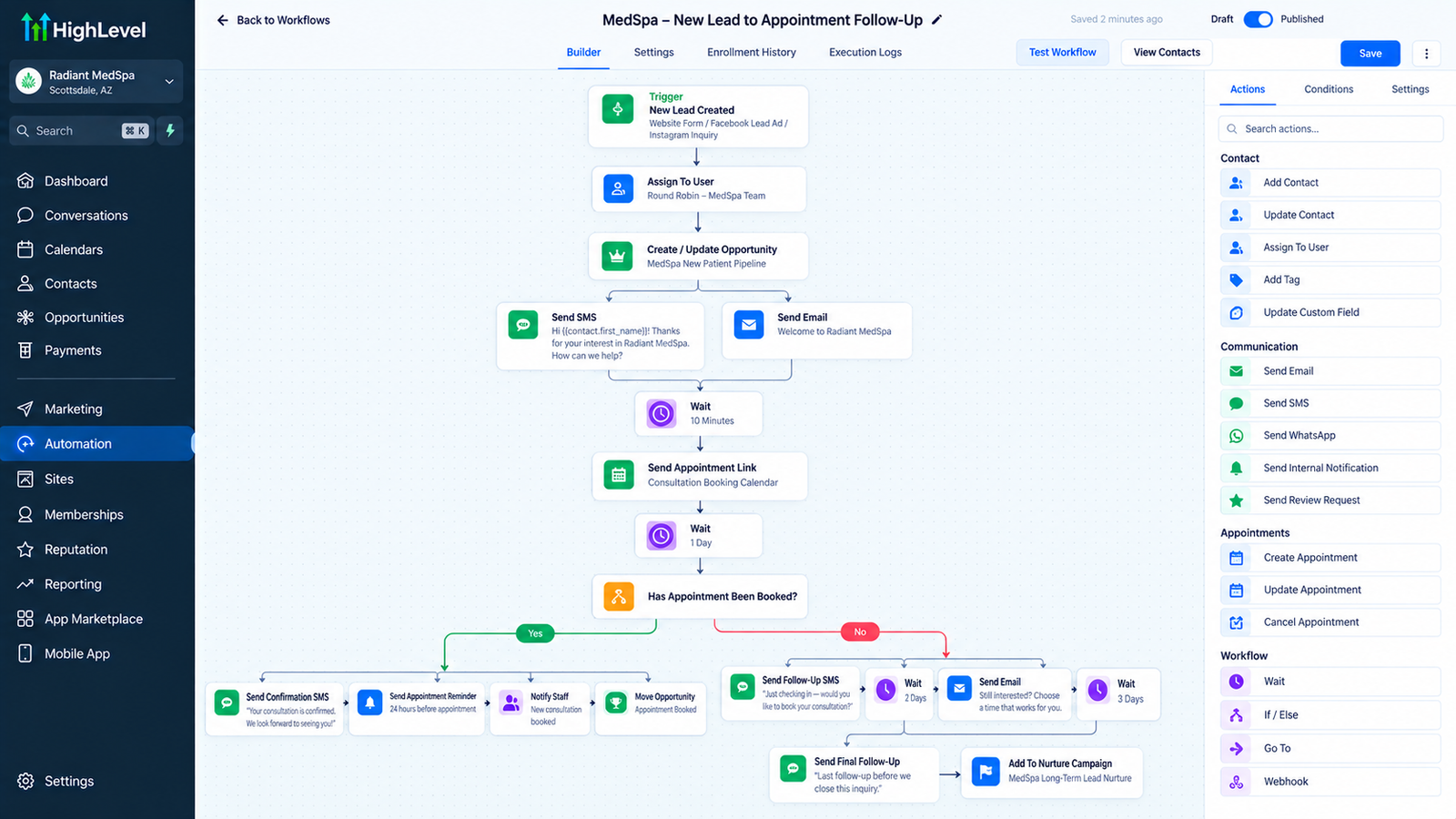
The workflow starts with a tag applied automatically when an appointment is marked as a no-show in the calendar. That tag triggers a short sequence: a same-day text acknowledging the missed appointment without blame, offering an easy way to rebook, followed by one or two additional touches over the following days if the client hasn’t responded. The sequence needs an explicit exit condition, the client rebooks, so it stops the moment the actual problem is solved rather than continuing to message someone who already handled it.
Some practices layer a policy reminder into this sequence (deposit requirements, cancellation windows) if repeated no-shows are a recurring issue with a specific client. That’s a business-policy decision each practice needs to make on its own, but the automation itself, tag on no-show, trigger a specific recovery sequence, exit on rebooking, is the same structural pattern regardless of what policy sits behind it.
Automate membership and package renewal follow-up
Med spas running membership programs or prepaid treatment packages have a renewal problem that a flat calendar reminder doesn’t solve well. Clients start memberships on different dates and use package units at different rates, so a single renewal campaign sent to the whole list on the same day either reaches people too early, too late, or not at all relative to their actual situation.
The more reliable setup ties the renewal trigger to the client’s own data: a custom field tracking membership renewal date, or a package field tracking remaining treatment units. A workflow checks that field and fires a renewal reminder a set number of days before the actual renewal date, or when remaining units drop to a defined threshold (for example, one treatment left in a six-pack laser package). This requires more setup than a single blast campaign, building the custom fields, populating them accurately as treatments are used or memberships bill, and configuring the trigger logic, but it’s the difference between a renewal reminder that lands at the right moment and one that reads as a mistimed generic promotion.
Package expiration follow-up deserves its own smaller workflow. A client with an unused, soon-to-expire package unit is a strong candidate for a quick “you still have a session available” reminder, since letting that unit expire unused is a poor outcome for both the client and the practice’s retention numbers.
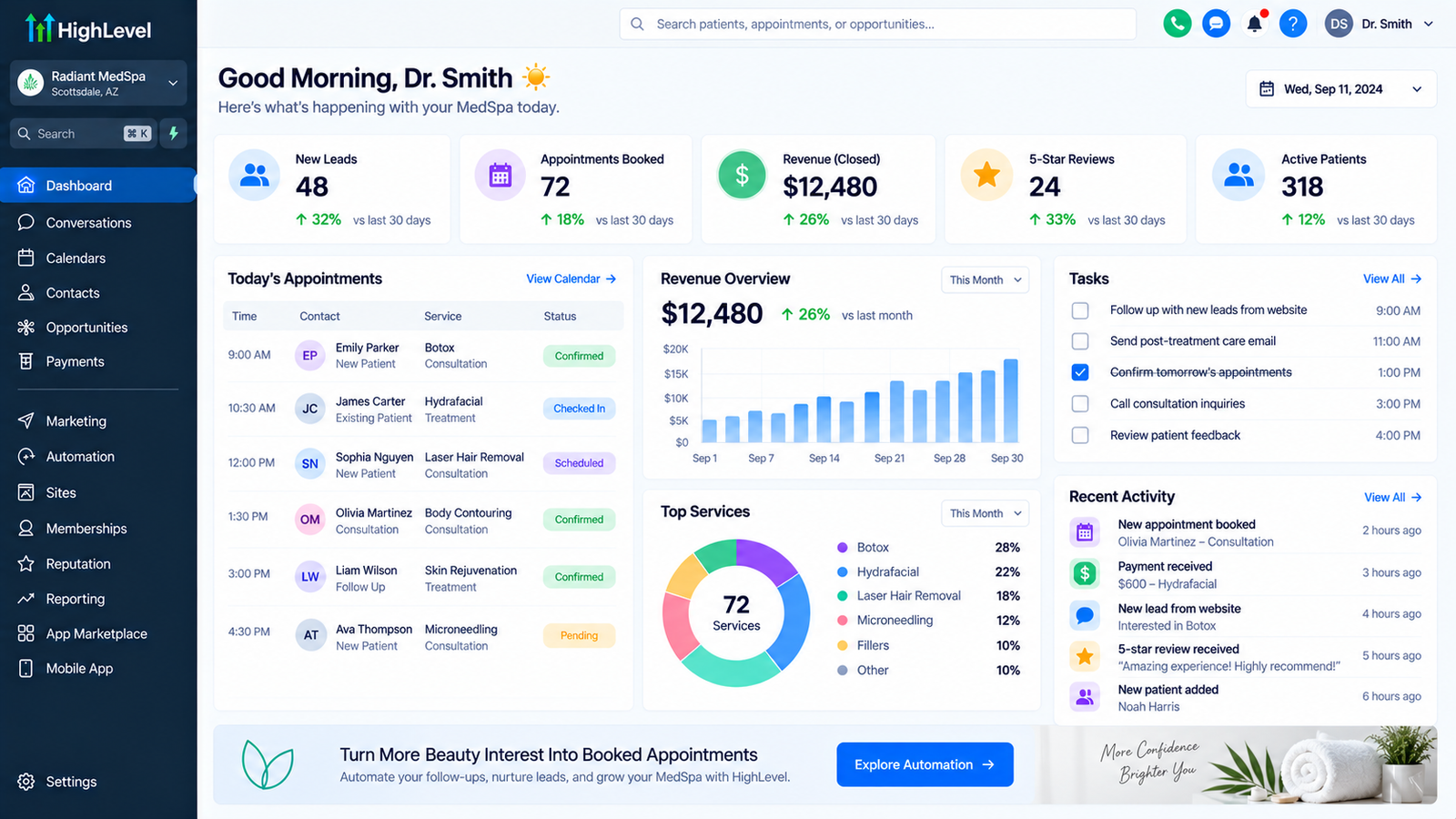 Illustrative example of a GoHighLevel pipeline view for a fictional med spa practice, built to show how appointment and membership stages might be organized. Names and figures shown are invented sample data, not an actual client’s account.
Segment by treatment interest so follow-up stays relevant
A client who asks about Botox and a client who asks about laser hair removal have different concerns, different price sensitivity, and different services worth mentioning in follow-up. Treating both leads identically in one generic newsletter list wastes the segmentation GoHighLevel is actually built to support.
The setup starts with tagging. When a lead inquires about or books a specific service, injectables, laser, skincare, body contouring, a tag records that interest on the contact record. That tag then determines which nurture content, promotions, and related-service suggestions the contact receives going forward. A client tagged for injectables might later receive information about a complementary skincare service that pairs well with their existing treatment, while a client tagged for laser hair removal sees content relevant to that treatment’s typical course length and touch-up schedule, rather than both getting the exact same monthly email.
This segmentation also improves review requests and renewal messaging, since a message referencing the client’s actual treatment history reads as attentive rather than generic. Getting the tag structure right during setup, deciding which service categories matter enough to warrant their own tag and workflow branch, is worth doing deliberately rather than tagging ad hoc after workflows are already built around a flat contact list.
A practical starting point is limiting the initial tag set to the service lines that actually drive volume, injectables, laser, and skincare are a common baseline, then adding a body-contouring or wellness tag only once that service line has enough contacts to justify a dedicated workflow branch. Building ten narrow tags before any of them has real volume behind it tends to create maintenance overhead without a matching payoff, since each tag needs its own nurture content kept current.
Automate review generation around the right moment
Timing matters more than wording for review requests. A request sent immediately after a positive outcome, a satisfying consultation, a completed treatment package, a follow-up visit showing good results, converts at a meaningfully higher rate than one sent on a fixed delay regardless of how the appointment actually went.
A straightforward setup triggers a review request text or email a day or two after an appointment is marked complete, with a direct link to the practice’s preferred review platform. Some practices add a private feedback step first, a quick “how did we do” message that routes a dissatisfied response to internal follow-up instead of a public review platform, while a positive response proceeds to the public review ask. This pattern needs to apply the same way to everyone rather than selectively skipping clients believed to be unhappy, since selectively soliciting only satisfied clients can run against some review platforms’ policies on review solicitation.
Building this as its own workflow, separate from the appointment reminder sequence, keeps the timing and messaging clean and makes it easy to adjust the trigger delay or wording later without touching the reminder logic.
What a med spa automation build actually requires
Most of what’s covered here fits inside a standard GoHighLevel single-business setup, adapted specifically to a med spa’s service menu and appointment types rather than left as a generic snapshot. The core pieces are the calendar and booking configuration, the reminder and no-show workflows, the membership and package custom fields with their renewal triggers, the treatment-interest tagging structure, and the review-request workflow, each built and tested against the practice’s actual services rather than assumed to work out of the box from a template built for a different kind of business.
None of this replaces a compliant intake and consent process. Automation handles scheduling, reminders, and marketing communication; medical intake forms, consent documentation, and any HIPAA-sensitive communication should be scoped separately with attention to what tier of GoHighLevel (or which additional safeguards) your specific data flow actually requires, confirmed with your own compliance advisor rather than assumed from a general guide.
The bottom line for med spas using GoHighLevel
Med spas that get real value out of GoHighLevel treat lead response speed, no-show recovery, and treatment-based segmentation as the priority builds, not an afterthought layered onto a generic marketing snapshot. Fast, specific replies to injectable and laser inquiries capture leads that would otherwise book with a faster-responding competitor. No-show recovery and renewal automation tied to real appointment and membership data recover revenue a flat, one-size-fits-all reminder schedule misses, and segmenting by treatment interest means every follow-up message reads as relevant rather than generic. A practice weighing whether to build this internally or bring in outside help can start with the GoHighLevel implementation services page for a breakdown of what a properly scoped setup involves.