
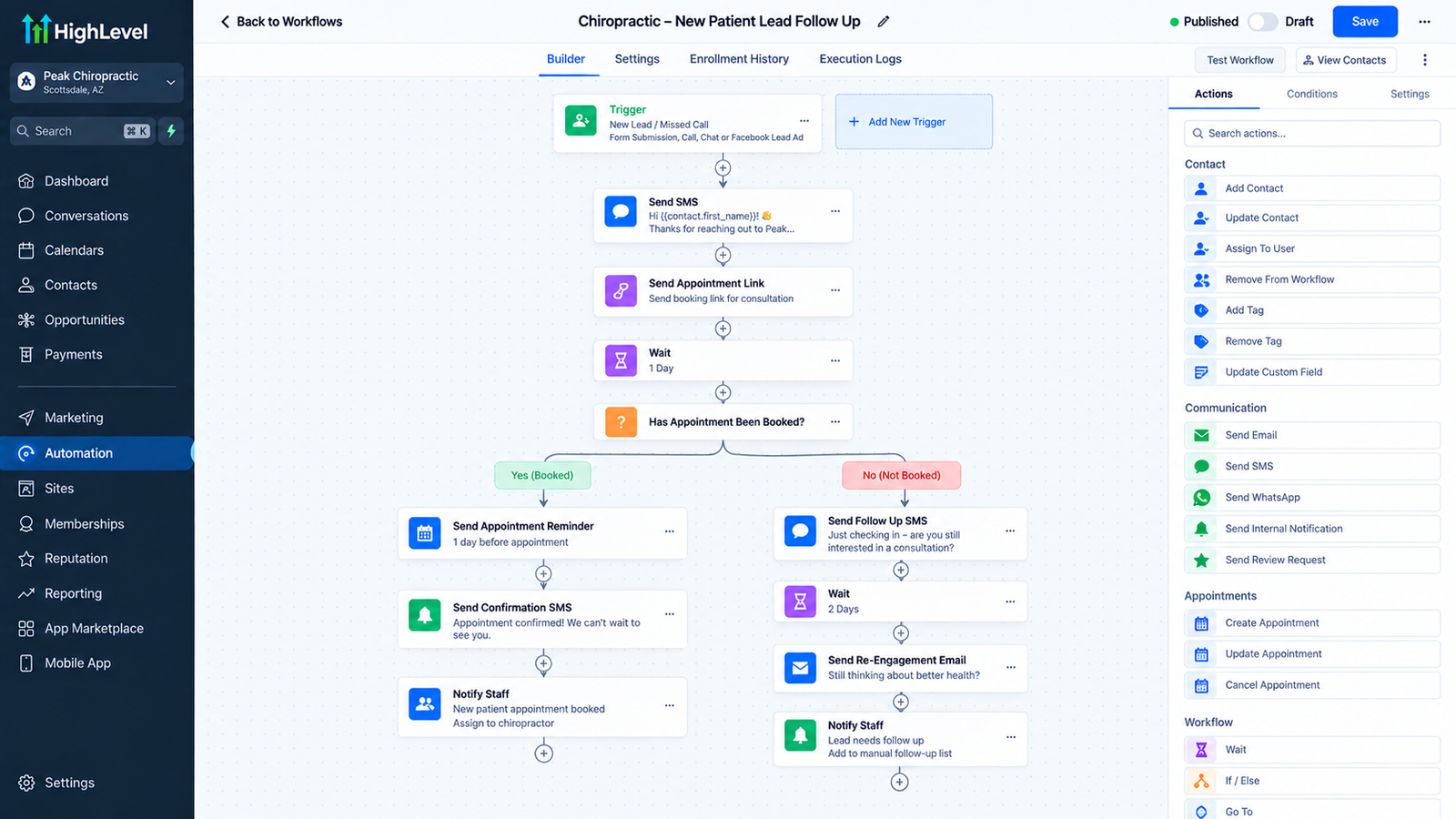
GoHighLevel for Chiropractors: A Practical Automation Guide
How chiropractic practices use GoHighLevel to speed up new patient response, cut no-shows, recover lapsed patients, and automate review requests across single and multi-location practices.
Key takeaways
- New patient inquiries need a response within minutes, not hours, because someone in pain searching for a chiropractor is usually calling or messaging more than one practice and books with whoever answers first.
- Appointment reminder sequences work best as a staged cadence, several days out, the day before, and a few hours before, rather than a single reminder, since each stage catches a different reason a patient might otherwise miss the visit.
- No-show recovery needs to happen the same day a patient misses an appointment, with a clear, low-friction rebooking link, because the longer the gap after a missed visit, the less likely that patient returns at all.
- Treatment-plan follow-up automation matters most for practices running multi-visit care plans, where a patient who skips week three of a twelve-visit plan needs a nudge before they quietly stop coming rather than after.
- Review requests convert best when they're triggered right after a positive interaction, typically shortly after a completed visit, rather than in a generic monthly batch sent to the entire patient list.
- Multi-provider and multi-location chiropractic groups need routing and reporting built by location and by provider, since lumping all patients into one shared pipeline makes it impossible to see which location or provider actually needs support with recall or reminders.
Chiropractic practices lose more patients to slow response times, missed reminders, and quiet no-show attrition than to any competitor down the street. GoHighLevel addresses each of those points directly: a workflow that responds to a new inquiry within minutes, a staged reminder sequence that actually reduces missed visits, same-day no-show recovery outreach, treatment-plan follow-up that catches a patient before they drop off a multi-visit care plan, review requests timed to a patient’s best moment, and, for groups running more than one provider or location, routing and reporting that doesn’t collapse everyone into one undifferentiated pipeline. None of this requires guessing; it requires building the automation around the specific points where chiropractic patients actually fall out of the funnel.
New patient inquiry response speed
A person searching for a chiropractor is frequently dealing with acute pain, which means they’re motivated to act quickly and often contacting more than one practice at the same time. The practice that responds first, with a clear next step rather than a vague “we’ll call you back,” tends to win the appointment. A form submission or missed call that sits in an inbox until someone gets to it during a lull between patients is a lost new patient more often than practices realize, because the person has usually already called the next name on their search results.
The fix is the same principle that applies across any inbound-lead business: automate the acknowledgment, then get a human on the phone as fast as the schedule allows. A workflow triggered by a website form, a missed call, or a booking-widget inquiry should send an immediate text confirming receipt and offering a link to select an appointment time, while simultaneously creating a task for front desk staff to follow up with a call. For a practice that gets a meaningful share of after-hours inquiries, this matters even more, since an automated response overnight keeps the lead warm until the office opens rather than losing an entire evening’s worth of interest to silence.
Appointment reminder sequences that actually reduce misses
A single reminder text the day before an appointment catches some patients and misses others, particularly the ones who booked weeks in advance and simply forgot the visit existed by the time it arrived. A staged reminder sequence covers more of the reasons patients miss appointments: a message several days out helps patients who scheduled far ahead re-confirm the date is still workable, a day-before reminder catches most routine forgetfulness, and a same-day, few-hours-before message catches the patients who need a final nudge or who might otherwise get pulled away by a conflicting commitment.
Each reminder should make rescheduling as easy as confirming, with a direct link rather than a phone number a patient has to call during business hours. A patient who wants to reschedule but faces friction doing so is more likely to simply not show up than to make the call. Building the reschedule link into every stage of the sequence, not just the final one, reduces the number of true no-shows versus patients who proactively moved their visit.
No-show recovery and reactivation campaigns
The gap between a missed appointment and outreach matters more than almost any other variable in getting that patient back on the schedule. A same-day message, ideally within an hour or two of the missed slot, has a real chance of reaching a patient while the appointment is still top of mind and rebooking feels like an easy correction rather than a hurdle. Wait until the next day or later, and the patient has often mentally moved on, especially if the reason they missed the visit was that their pain had temporarily improved.
The recovery message itself should be short, non-judgmental, and built around a direct rebooking link rather than a request to call the office. For patients who don’t respond to the same-day message, a secondary reactivation sequence, spaced out over the following weeks, keeps the door open without becoming repetitive: a check-in a few days later, then a longer-interval nudge if there’s still no response. This same reactivation logic extends to patients who haven’t been in for a routine visit in a while, not just a specific missed appointment. A workflow that flags patients past their expected recall interval, whether that’s a maintenance visit schedule or a general checkup cadence, and sends a re-engagement message is what keeps a patient list from quietly going stale between active treatment plans.
Treatment-plan follow-up automation
Multi-visit care plans, common in chiropractic treatment for injuries or ongoing conditions, are especially vulnerable to quiet attrition. A patient starts feeling better after a few visits and skips the remaining sessions in the plan without formally canceling anything, which means nobody at the practice notices until the patient simply stops showing up on the schedule.
Tracking treatment-plan progress on the patient’s contact record, through a pipeline stage or a custom field noting which visit number they’re on and how many remain, lets a workflow catch this pattern early. If a patient misses an expected visit within an active plan, a check-in message can go out asking how they’re doing and offering to help reschedule, rather than waiting for the practice to notice a gap on a spreadsheet weeks later. This isn’t about pressuring a patient who’s genuinely finished improving; it’s about catching the patients who intended to complete the plan and simply let scheduling slip, which is a meaningfully different problem than a patient who’s decided to stop treatment on purpose.
Review request automation
Timing determines most of the difference between a review request that gets ignored and one that gets completed. A request sent shortly after a positive visit, when the patient’s relief or satisfaction is fresh, converts at a noticeably higher rate than the same request sent as part of a generic monthly email blast to the entire patient list. A workflow triggered by appointment completion, rather than a scheduled batch send, also naturally avoids surfacing a review request to a patient who just had a difficult or negative visit, since it’s tied to that specific appointment rather than firing on a calendar regardless of context.
A practical sequence sends the request within a few hours of a completed visit, with a direct link to the review platform the practice actually wants reviews on, and a brief, genuine message rather than anything that reads as scripted or transactional. For patients who don’t leave a review after the first request, a single, spaced-out follow-up is usually enough; repeated requests past that point tend to annoy more than they convert.
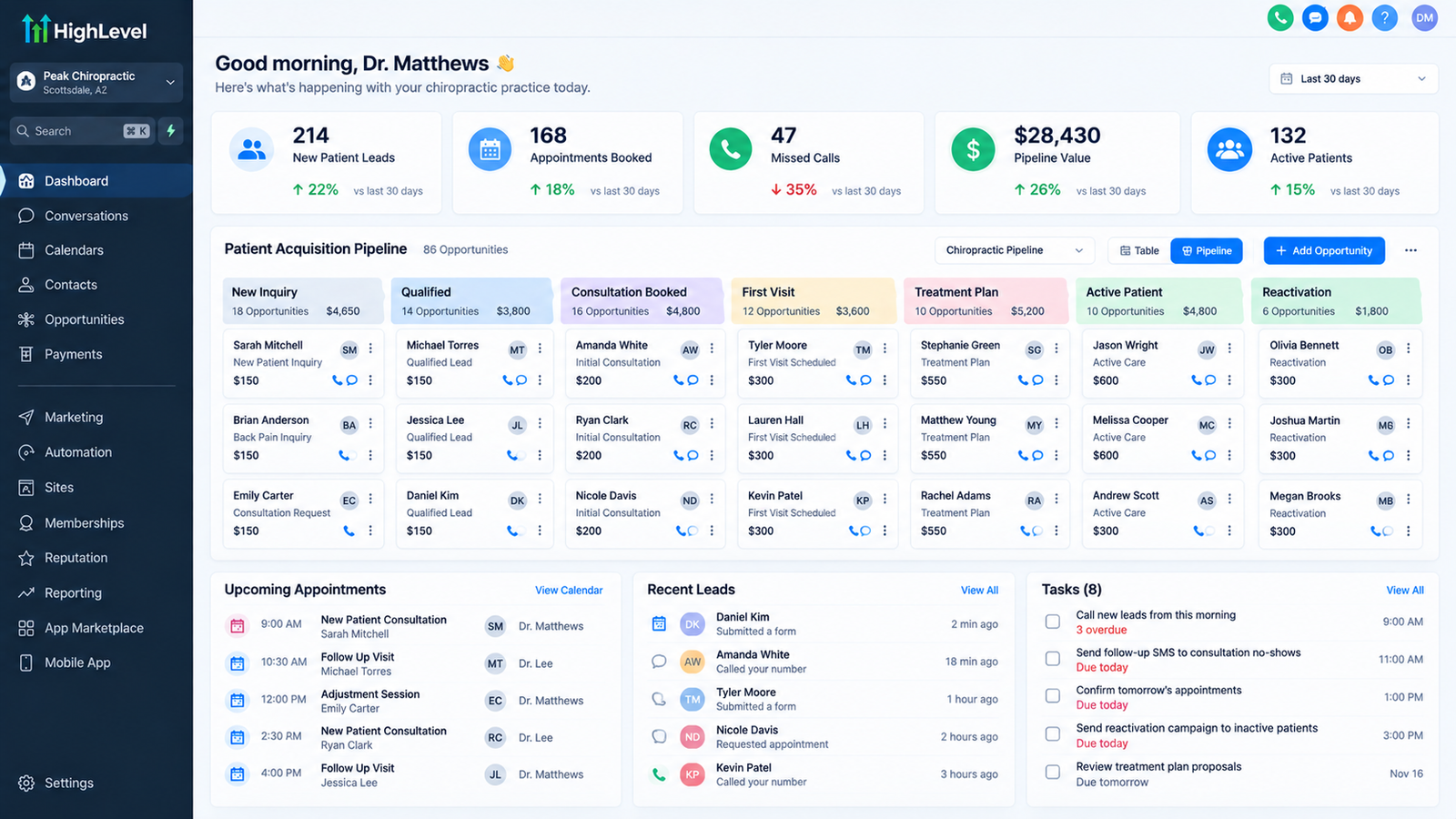 Illustrative example of a GoHighLevel pipeline view for a chiropractic practice, built with a fictional practice name and invented sample data for demonstration purposes only, not an actual client account.
Multi-provider and multi-location considerations
A chiropractic group running more than one provider or more than one location faces a structural question similar to any multi-location service business: which parts of the automation get shared, and which need to stay separate. Reminder sequences, review-request templates, and no-show recovery logic can generally be built once and deployed across every location, since the underlying patient behavior and messaging don’t need to differ much location to location.
What does need separation is anything tied to a specific location’s operations or a specific provider’s schedule: phone numbers used for texting and calling, appointment scheduling windows if locations run different hours, and reporting on response time, no-show rate, and recall outreach broken out by location and provider. Without that breakout, a group has no way to see that one location is responding to new patient inquiries in ten minutes while another is taking most of a day, or that one provider’s patients are missing follow-up visits at a noticeably higher rate than another’s. That visibility is what lets a practice manager act on a specific, fixable problem instead of only seeing an aggregate number across the whole group that hides where the actual gap is.
A dedicated phone number per location also matters for a reason that has nothing to do with reporting: a shared number across sites makes it impossible to route an inbound call or text to the right front desk without a manual transfer, and it muddies A2P texting compliance since carriers expect a consistent sender identity tied to a specific business location. Provisioning a distinct number per site during setup avoids having to retrofit that separation later, once patients are already used to texting a shared line.
Rebuild or fix: reading the signals
Some chiropractic CRM problems are quick corrections. A reminder sequence sending only one message instead of the intended staged cadence usually means a workflow step got disabled or misconfigured, not that the whole reminder system needs rebuilding. A review request going out to a patient who had a bad visit is often a trigger condition that needs a small adjustment, not a sign the automation approach is wrong.
A structural gap looks different: no automated response to new inquiries at all, no tracking of treatment-plan progress so patients drop off unnoticed, or a multi-location group with no way to see performance broken out by site. Those need real setup work, because they’re missing pieces of the system rather than a misconfigured detail inside an existing one, and they’re worth prioritizing before adding more patient volume on top of a system that isn’t following up on the patients already coming through the door.
The bottom line for chiropractic practices using GoHighLevel
The chiropractic practices getting the most out of GoHighLevel aren’t running the most complicated automation setups. They’re covering the specific moments where patients actually fall through: the first few minutes after a new inquiry, the days leading up to an appointment, the hours right after a missed visit, the middle of a multi-visit treatment plan, and the moment right after a good visit when a review is easiest to ask for. Multi-location groups add one more layer on top: keeping that same coverage visible and manageable by location and provider rather than blended into one number nobody can act on. For a practice or group ready to scope this out, the GoHighLevel implementation services page walks through what a properly structured project includes, and the GoHighLevel agency setup guide is worth reading alongside it if you’re managing more than one practice location.