
GoHighLevel for Digital Agencies: Automating Your Own Client Pipeline
How marketing agencies use GoHighLevel to run their own sales, onboarding and retention automation, not client setups, but the agency's own client acquisition pipeline.
Key takeaways
- There are two entirely different GoHighLevel projects an agency runs: configuring the platform for clients (sub-accounts, snapshots, white-label), and running the agency's own sales and retention pipeline on it. This post is about the second one.
- Discovery-call booking automation that qualifies a lead before the call (budget range, current tools, timeline) saves far more agency time than automation applied after the call, since a large share of unqualified calls never should have been booked in the first place.
- Proposal follow-up is the single most commonly neglected agency sales stage: a proposal sent and never followed up on systematically converts worse than one followed by a scheduled, automated check-in sequence.
- New client onboarding automation (welcome sequence, kickoff scheduling, access/credential collection, first-30-days check-ins) reduces the single biggest source of early-churn risk: a client who feels ignored in the first month, regardless of how good the actual work turns out to be.
- Churn-risk flagging works best as a rule built on measurable signals (missed check-in calls, declining engagement with reports, support ticket sentiment) rather than waiting for a client to explicitly say they're unhappy or considering leaving.
- An agency reselling GoHighLevel to clients while also running its own sales pipeline on the same platform needs clean separation between the agency's own sub-account and client sub-accounts. Mixing them creates reporting and access confusion as the agency scales.
Most content about GoHighLevel and agencies covers one thing: configuring the platform for clients. This post is about the other project, an agency using GoHighLevel as its own CRM to run its own client acquisition, onboarding and retention, separate from whatever it’s building or reselling to clients.
These are genuinely different jobs, and an agency can need one, both, or neither. If the technical setup side, sub-accounts, snapshots, white-labeling, is what you’re after, the GoHighLevel agency setup guide covers that in depth. This post assumes that part is either already handled or irrelevant, and focuses on the agency’s own sales and retention pipeline.
Lead capture from the agency’s own marketing
An agency’s own website, ad campaigns, referral links and content all generate inbound interest that needs to land somewhere structured, not scattered across a shared inbox and a founder’s memory. The same speed-to-lead principle that applies to any business applies here: a form fill or ad-generated inquiry gets an automated acknowledgment and a task for the sales owner immediately, not whenever someone happens to check the inbox.
Source matters just as much as speed for an agency’s own pipeline, since a referral from a past client, a paid ad click, and an organic content download represent three different levels of intent and typically warrant three different first messages. Tagging a lead by source at the point of capture, rather than trying to reconstruct it later from a spreadsheet or ad platform export, lets the sales owner see at a glance whether they’re talking to someone who already trusts the agency (a referral) or someone still forming a first impression (a cold ad click), and adjust the opening conversation accordingly. It also makes channel-level reporting possible later: which source actually produces booked calls, and which one just produces form fills that go nowhere.
Qualifying before the call, not during it
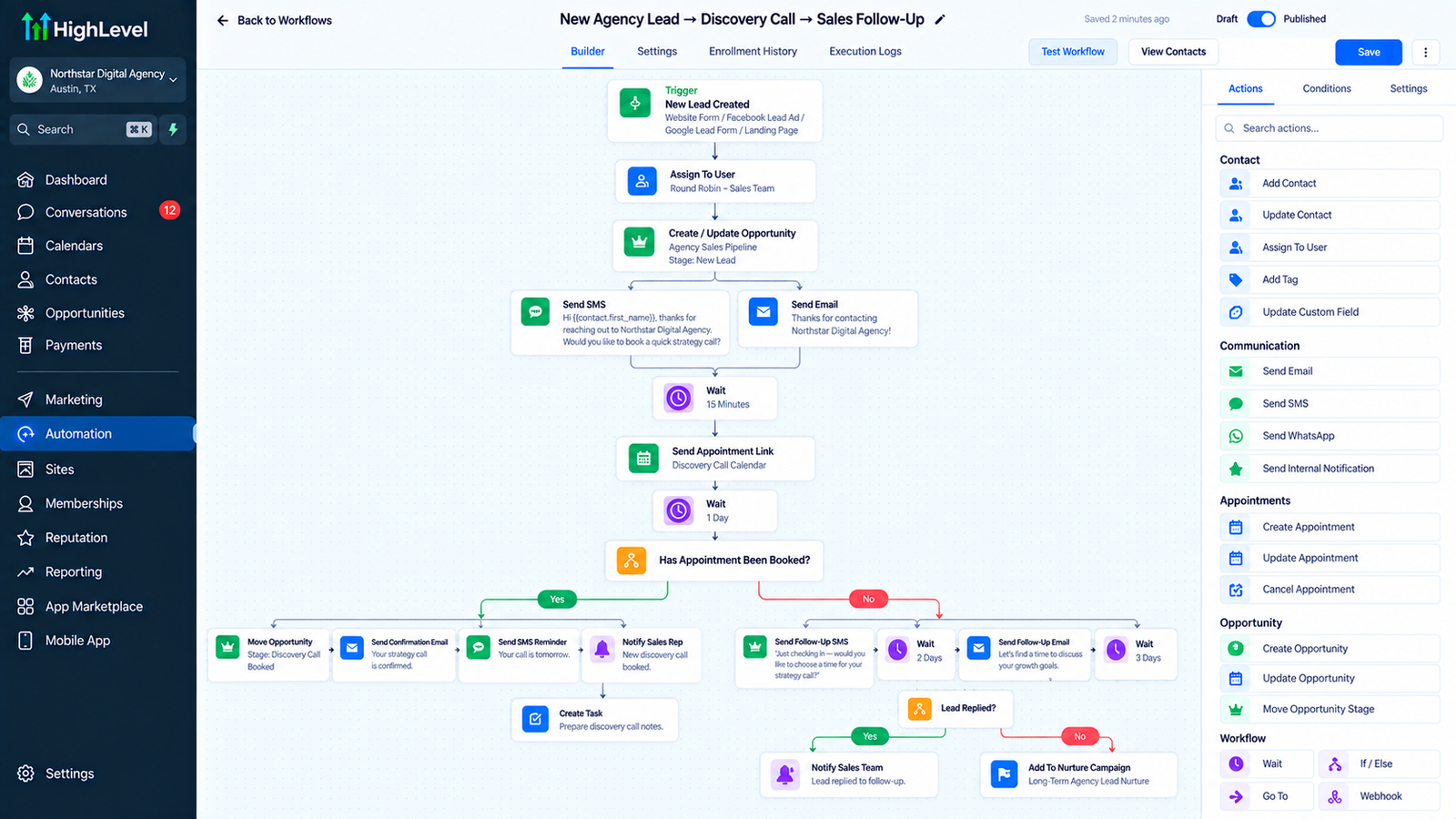
A discovery call with an unqualified lead wastes time on both sides. A short qualifying step before the call gets booked, budget range, current marketing tools or CRM, general timeline for starting, routes clearly-poor-fit leads into a nurture sequence instead of a live call slot, and gives leads who do fit a call that starts from actual context instead of the salesperson re-asking basic questions they could have captured automatically.
This doesn’t need to be an intrusive form. A short quiz-style form, or a quick automated text/chat exchange before the calendar link unlocks, is usually enough to filter meaningfully without adding real friction for a genuinely interested lead.
Proposal follow-up: the stage agencies most commonly drop
A proposal sent and never followed up on systematically is one of the most common, least-discussed leaks in agency sales. It’s easy to send a proposal and intend to follow up personally, and just as easy for that intention to lose out to delivery work, a new lead, or simple forgetting once a few days pass.
A workflow triggered when a proposal is marked sent removes that dependency: a scheduled sequence of check-ins over the following one to two weeks, referencing the specific proposal and offering a concrete next step rather than a generic “just checking in.” This alone recovers deals that would otherwise quietly go cold, not because the prospect said no, but because nobody followed up in time to get an actual answer.
Onboarding automation for new clients
The first 30 days of a client relationship are when confidence is most fragile, regardless of how strong the actual deliverable work turns out to be later. A new client who feels ignored in week one forms an impression that’s hard to undo, even if month three’s results are excellent.
Structured onboarding automation typically includes:
- A welcome sequence confirming the engagement, timeline and what happens next
- Automated kickoff call scheduling, so the first real touchpoint happens quickly rather than waiting on manual coordination
- A structured request for access and credentials needed to start work (ad accounts, website, analytics, existing tool logins), collected once, clearly, instead of piecemeal over several back-and-forth messages
- A first-30-days check-in sequence specifically, separate from the ongoing account-management cadence that follows afterward
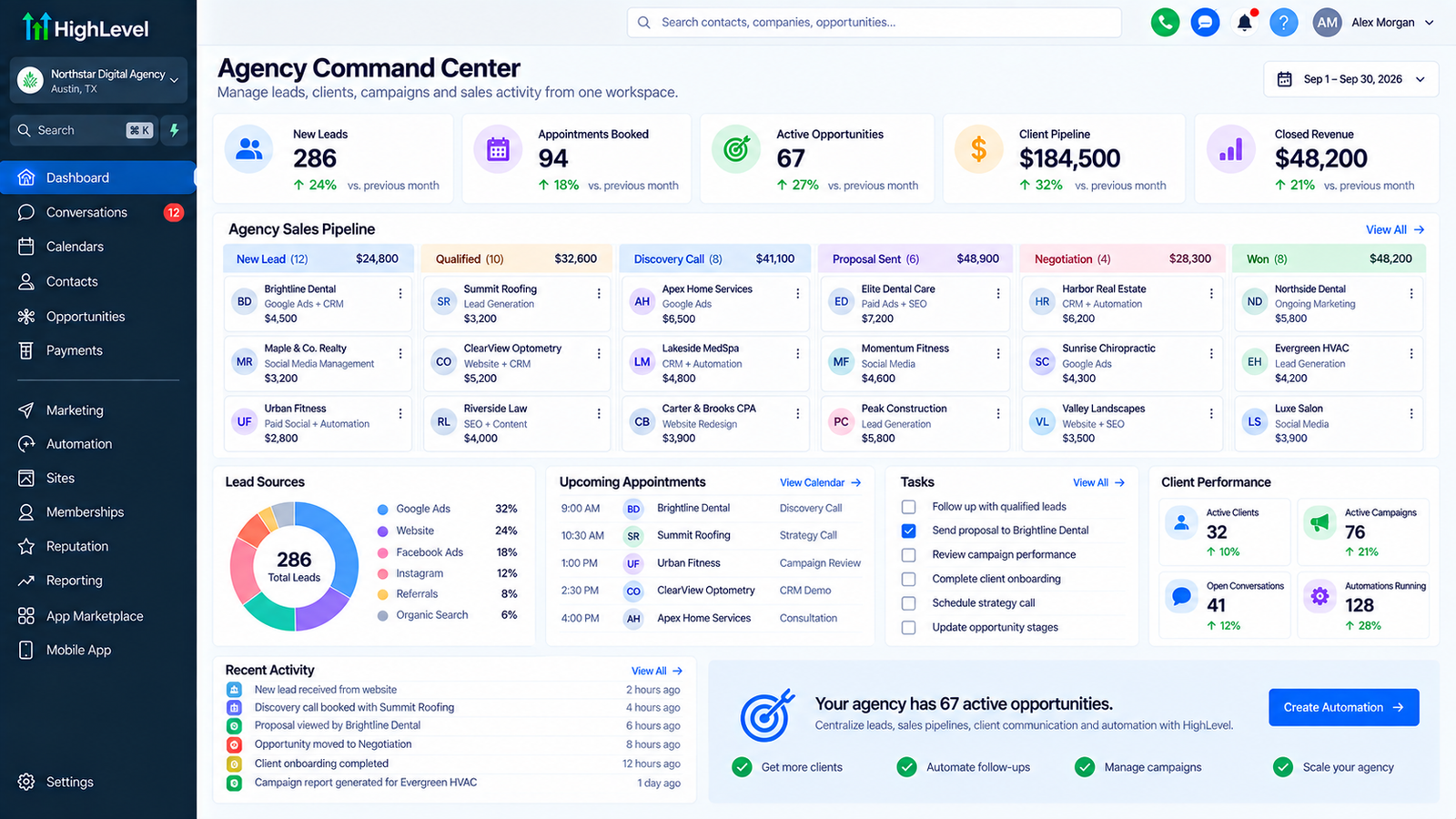 Illustrative example of a GoHighLevel pipeline view for an agency’s own client acquisition process, built with a fictional agency name and invented sample data for demonstration purposes only, not an actual client account.
Flagging churn risk before a client says anything
By the time a client explicitly says they’re considering leaving, the relationship has usually already been deteriorating for a while. Behavioral signals tend to show up earlier: missed or repeatedly rescheduled check-in calls, declining engagement with performance reports (not opening them, no questions, no reaction to results either way), or a shift in tone across support interactions.
A workflow that tracks these signals and flags an account once several stack up gives account management a real chance to intervene, a proactive call, a candid check-in about satisfaction, before the client has fully decided to leave rather than after.
Keeping the agency’s own pipeline separate from client sub-accounts
An agency that both runs its own sales pipeline on GoHighLevel and resells or configures GoHighLevel for clients needs clean separation between the two. The agency’s own sales and client-management data should live in its own sub-account, distinct from the sub-accounts provisioned for (or resold to) clients.
Mixing them might seem convenient early on, but it creates real reporting confusion and unnecessary access-control exposure as both the agency’s own client roster and its resold account base grow. It’s a problem that’s straightforward to avoid from the start and considerably more annoying to untangle later.
Where this fits with the rest of an agency’s GoHighLevel use
Running the agency’s own acquisition and retention pipeline on GoHighLevel is a genuinely separate project from configuring it for clients, but the two aren’t unrelated. An agency that understands its own sales and retention automation deeply tends to build noticeably better client setups, because it’s living with the same platform’s real strengths and limitations on its own business. The GoHighLevel agency setup guide is the companion piece for the technical build side, and GoHighLevel implementation services is where to start if you’d rather have either project scoped by someone who’s built both before.