
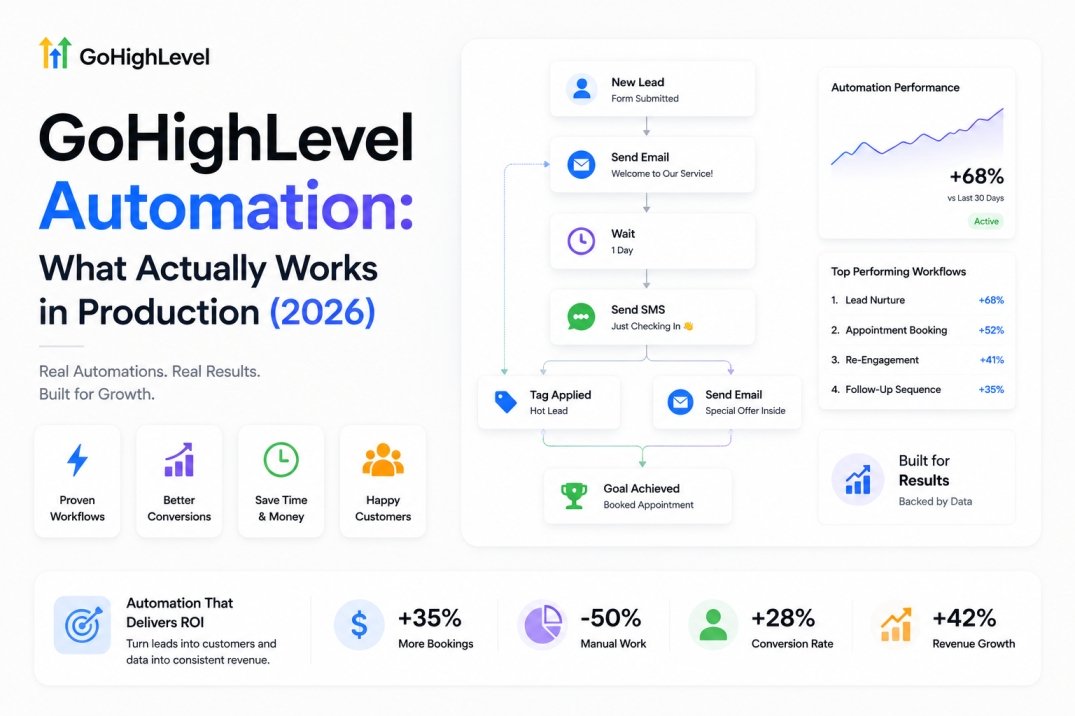
GoHighLevel Automation ROI in 2026: What Actually Moves the Number
A practical framework for estimating real ROI from GoHighLevel automation, where the returns are genuine versus overstated, and a full map of aibrevo's GoHighLevel guides.
Key takeaways
- The most reliably measurable ROI driver in a GoHighLevel build is speed-to-lead: faster response time has a direct, trackable relationship to lead-to-opportunity conversion rate, and that conversion delta is the cleanest number to model before investing in a build.
- The most commonly overstated ROI claim in GoHighLevel marketing is a flat multiplier ('3x your revenue') applied without reference to a specific business's actual lead volume, close rate, or deal value. A framework beats a borrowed number every time.
- The real cost automation replaces isn't a salary line, it's the compounding cost of leads and follow-ups that silently fall through manual gaps. That number is usually invisible until someone actually audits how many leads went untouched in a given month.
- Automation ROI is front-loaded in acquisition (speed-to-lead, nurture, routing) and back-loaded in retention (churn flagging, reactivation, expansion). A build that only covers the front half systematically underestimates its own long-term return.
- Implementation cost is a fixed, mostly one-time number ($500-$12,000 depending on scope, per aibrevo's published GoHighLevel pricing); the return compounds over every month the automation keeps running, which is why the relevant comparison is cost against a full year of impact, not against the first month.
- A business that hasn't fixed foundational setup issues (workflows not triggering, broken calendar sync, email deliverability problems) will see automation ROI numbers that look artificially low, because the automation isn't actually running correctly, not because the underlying strategy is wrong.
“Is GoHighLevel automation actually worth it?” is really two questions wearing one sentence. The first is whether automation, in general, is worth it for a business like this. The second, separate question is whether this specific build, at this specific cost, is going to pay for itself. The first question has a fairly durable answer. The second one depends entirely on numbers that are different for every business, which is exactly why a borrowed ROI multiplier from someone else’s marketing is worth less than a framework applied to your own.
Where automation ROI is genuinely measurable
Speed-to-lead is the cleanest number in the entire category. There’s a direct, trackable relationship between how fast a new lead gets a first response and how likely that lead converts into a real opportunity. This isn’t a claim that requires trusting anyone’s marketing. It’s measurable inside a single business’s own CRM data, before and after automating the first response.
Missed-call and after-hours recovery is nearly as clean. A call that goes unanswered and gets no follow-up is a lead that, in most competitive markets, simply goes to whoever answers next. An automated text-back the moment a call is missed recovers some meaningful share of leads that would otherwise be gone entirely. The honest way to estimate this is tracking how many calls currently go unanswered in a typical month, not assuming a number.
Both of these are worth baselining before a build even starts, not after. A business that can say “we currently answer new inquiries within four hours on average, and roughly 15% of our inbound calls go unanswered during business hours” has a real before-picture to compare against once automation is running. Without that baseline, the after-picture has nothing to be measured against, and the ROI conversation drifts back toward impression rather than evidence.
Follow-up consistency on proposals and quotes is a third reliable driver, for the simple reason that manual follow-up reliably degrades as volume grows. A workflow doesn’t forget to send the third follow-up message the way a busy person does.
Where ROI claims get overstated
The most common inflated claim is a flat multiplier, something like “clients see 3x their investment back,” presented without reference to a specific business’s lead volume, close rate, or average deal value. Those three inputs vary enormously between a solo chiropractor and a multi-location real estate brokerage, which means a multiplier borrowed from someone else’s business tells you almost nothing about yours.
A second overstated pattern is crediting automation for outcomes that were really driven by something else entirely: more ad spend, a stronger offer, a better sales rep, simply because the automation happened to be running at the same time. Automation amplifies whatever’s already working. It doesn’t manufacture demand or fix a genuinely weak offer, and a business that sees revenue climb after both a new ad budget and a new automation build launch in the same month should be honest with itself about which one actually did the heavier lifting.
A framework for estimating your own number
- Baseline the current state. How many leads come in per month, and how many currently get a response within an hour, within a day, or never at all?
- Estimate the conversion lift, conservatively. What’s the realistic improvement in lead-to-opportunity conversion from consistent fast response? Use a conservative estimate you could defend, not an optimistic one you can’t.
- Multiply by average deal value. The conversion lift, applied to current lead volume and average deal value, produces an estimated monthly revenue impact specific to your business.
- Compare against implementation cost as a one-time number against a full year of impact, not against the first month. A $500-$4,000 single-business GoHighLevel build (see the implementation cost guide for the full breakdown by tier) is a very different comparison against twelve months of recovered leads than against the first thirty days.
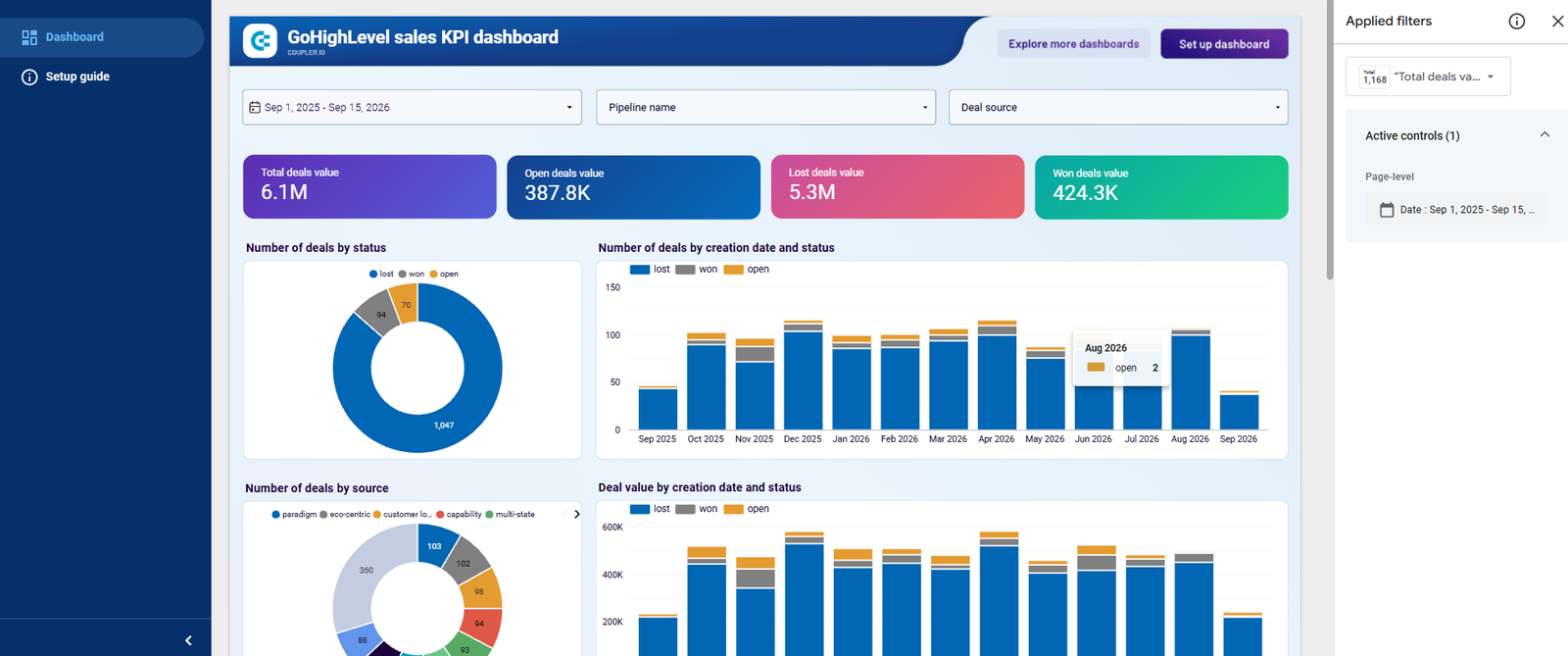 Illustrative example of a GoHighLevel reporting dashboard showing the specific metrics worth tracking as you build your own ROI baseline: deal volume and value by status, and how both trend month over month.
Acquisition ROI versus retention ROI
Most GoHighLevel builds get scoped around acquisition-side automation first: speed-to-lead, nurture sequences, routing. That’s a reasonable starting point, but it’s only half the available return. Retention-side automation, churn-risk flagging, reactivation campaigns for lapsed customers, expansion sequences for existing accounts, is usually cheaper to act on than acquiring a new customer from scratch, and it’s the half of the ROI equation that gets built later, or skipped, more often than it should be.
Part of why retention gets deprioritized is sequencing rather than judgment: a new build naturally starts with the front door, since there’s no point automating renewal reminders for customers a business isn’t yet reliably acquiring. The mistake isn’t building acquisition first, it’s stopping there once the front-of-funnel automation is stable and never circling back to add the retention layer on top, even after the business has enough of a customer base for reactivation and churn-flagging to start paying for themselves.
A typical breakdown of where implementation effort goes within a single-business GoHighLevel build, roughly proportional across aibrevo's $500-$4,000 tier. Multi-location and white-label builds shift more weight toward integration and testing as the number of sub-accounts and connected systems grows, and every project's actual split depends on scope.
The real cost automation replaces
It’s tempting to frame automation ROI against a salary line, something like “this replaces X hours of manual work,” but the more accurate framing is the compounding cost of leads and follow-ups that silently fall through manual gaps: the lead nobody called back inside the window that actually mattered, the quote that got sent and never followed up on again, the client who quietly disengaged without anyone noticing until they’d already decided to leave. This cost is mostly invisible until someone actually audits a typical month’s worth of leads and follow-ups, which is a useful exercise before assuming ROI is speculative rather than concrete and already happening in reverse.
Why a properly built account still sometimes underperforms
A business with a professionally built GoHighLevel setup can still see disappointing ROI numbers, and the cause is usually foundational, not strategic: a workflow that isn’t actually triggering the way it’s supposed to, calendar sync issues creating double-bookings that damage trust before a deal even closes, or emails landing in spam instead of the inbox because of an authentication gap. In each case, the fix is diagnosing and correcting the specific foundational issue, not redesigning the entire automation strategy around a symptom of something else being broken.
Where to go deeper
This post is the hub for aibrevo’s full GoHighLevel content: the setup, the cost, the common failure points, and the industry-specific playbooks.
Setup and cost
- GoHighLevel implementation services
- GoHighLevel implementation cost guide
- GoHighLevel for Agencies: The Complete Setup Guide
- GoHighLevel Sub-Accounts Explained
- GoHighLevel Snapshots Explained
Fixing common problems
- GoHighLevel Workflow Not Triggering? A Systematic Troubleshooting Guide
- A2P 10DLC Registration Rejected: How to Fix It
- GoHighLevel Google Calendar Not Syncing: Causes and Fixes
- GoHighLevel Email Deliverability: Fixing SPF, DKIM and DMARC
By industry
- GoHighLevel for Real Estate: Lead Automation That Actually Gets Followed Up On
- GoHighLevel for Chiropractors: Automation Guide
- GoHighLevel for Med Spas: Automation Guide
- GoHighLevel for HVAC Companies: Automation Guide
- GoHighLevel for Digital Agencies: Automating Your Own Client Pipeline
- GoHighLevel for Dental Practices: No-Show Recovery, Case Acceptance and Recall Automation
- GoHighLevel for Real Estate solutions page
Migrating in and comparing platforms