
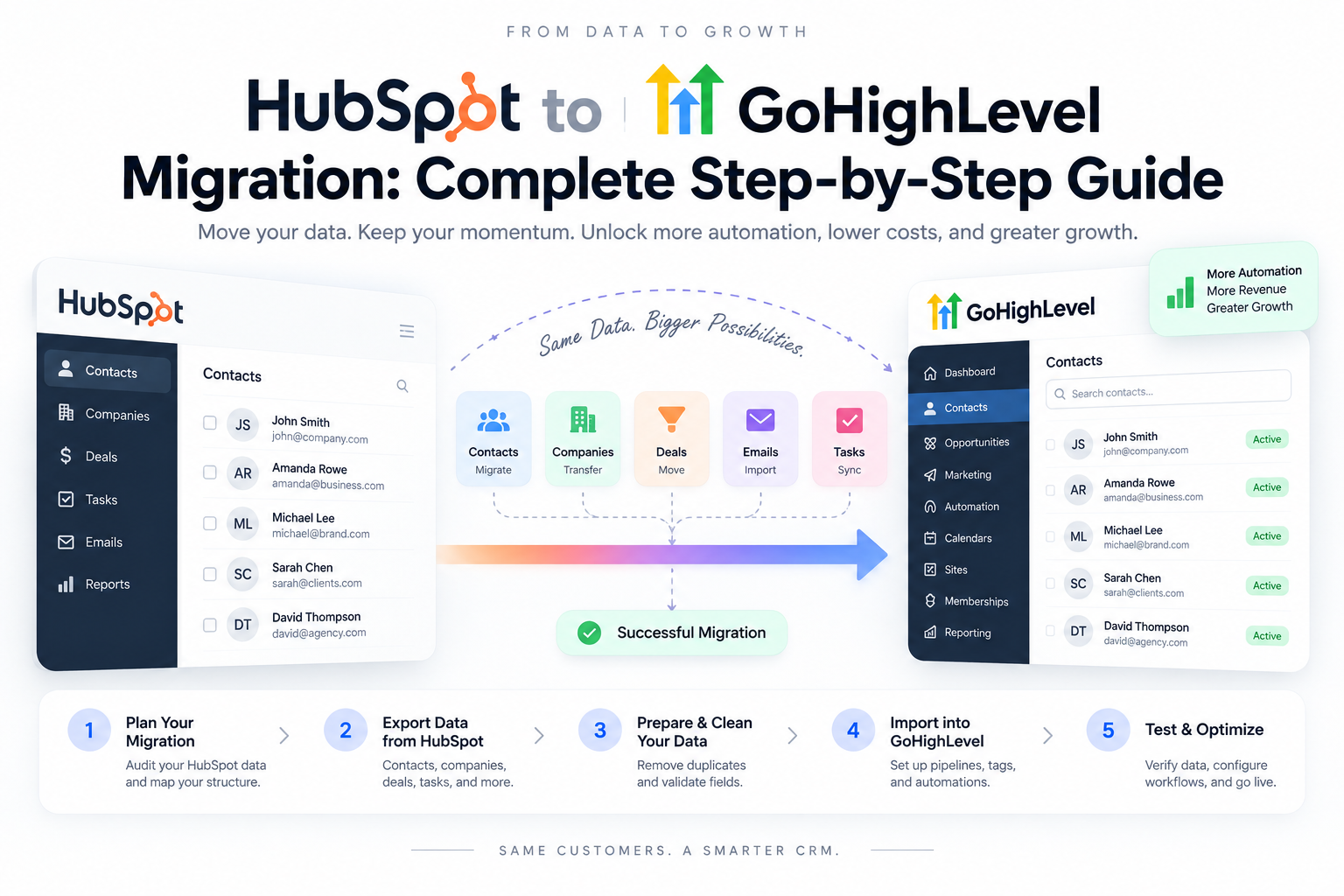
HubSpot to GoHighLevel Migration: A Complete Guide
How to migrate from HubSpot to GoHighLevel: why businesses switch, how the data models differ, a step-by-step migration plan, and what commonly breaks along the way.
Key takeaways
- HubSpot's lifecycle stages and deal pipelines don't map one-to-one onto GoHighLevel's opportunities and pipelines. GoHighLevel has no native lifecycle-stage concept, so that logic has to be rebuilt using tags and pipeline stages instead of ported directly.
- The most common reason businesses make this specific move is cost at scale: HubSpot's per-Hub, per-seat, per-contact-tier pricing grows with the business, while GoHighLevel's flat subscription plus usage-based communications wallet is more predictable for agencies and businesses running high contact volume or heavy SMS/call activity.
- Phone/SMS number porting and email-sending-domain re-authentication (SPF, DKIM, DMARC) are cutover-day risks specific to this migration direction, since GoHighLevel needs its own verified sending identity, not a copy of HubSpot's.
- HubSpot's native reporting (custom report builder, revenue attribution, multi-touch analytics) and many of its deep native integrations don't have a direct GoHighLevel equivalent. Some workflows and dashboards have to be rebuilt with a different tool, not migrated as-is.
- A parallel-run period, where both systems stay live and new leads flow into GoHighLevel while HubSpot stays in read-only for historical lookups, catches mapping errors before they become a permanent gap in reporting.
Businesses migrating from HubSpot to GoHighLevel are almost always chasing one of two things: a lower, more predictable bill as their contact list and Hub usage grow, or an all-in-one platform that bundles CRM, funnels, email, and phone/SMS without stitching together separate tools and integrations. The migration itself is straightforward in concept, export data, rebuild pipelines and automations, cut over, but GoHighLevel’s data model is different enough from HubSpot’s that a literal one-to-one import misses real functionality. This guide covers why the switch happens, what’s genuinely different between the two platforms, a realistic step-by-step plan, and what commonly gets lost in this specific migration direction.
If you’re earlier in the decision and haven’t fully committed to GoHighLevel yet, the GoHighLevel agency setup guide covers what a properly built GoHighLevel account looks like once you’re there. If you’re actually moving the other direction, into HubSpot rather than out of it, the migrating to HubSpot guide covers that path instead.
Why businesses move from HubSpot to GoHighLevel
Cost at scale
HubSpot prices by Hub (Marketing, Sales, Service, Operations), by seat, and by marketing-contact tier, which means the bill grows on three separate axes as a business adds contacts, users, or Hub functionality. A business that started on a low-tier HubSpot plan and later needed marketing automation, more seats, and a bigger contact allowance can find its subscription cost has multiplied without the underlying business growing at the same rate.
GoHighLevel’s pricing model is structurally different: a flat monthly subscription covers the platform itself (CRM, pipelines, funnels, calendars, workflow automation), with calling, texting and email sending billed through a separate usage-based wallet. For a business with a large contact list but moderate messaging volume, this often comes out meaningfully cheaper than HubSpot’s marketing-contact-tier pricing, since GoHighLevel doesn’t charge more for simply storing more contacts.
All-in-one consolidation
HubSpot is built as a suite of separate Hubs that share a common contact record, but achieving CRM, email marketing, funnel/landing pages, and phone/SMS in one HubSpot subscription usually means paying for multiple Hubs at once. GoHighLevel was built from the start as a single product covering CRM, funnels, websites, calendars, email, and native phone/SMS, without needing to license separate Hub-equivalents for each function. Businesses that were stitching together HubSpot plus a separate phone system plus a separate funnel builder often find that consolidation itself, not just the pricing, is the reason to switch.
Agency and reseller use cases
GoHighLevel supports white-label SaaS reselling: an agency can run client sub-accounts under its own brand, with its own billing, without clients ever seeing the GoHighLevel name. HubSpot doesn’t offer a comparable multi-tenant, resell-ready structure aimed at agencies managing many client accounts under one roof. Agencies serving small-business clients on HubSpot, where per-client Hub and seat costs add up quickly, commonly migrate specifically to unlock this reseller model, not purely to reduce their own internal software spend. The GoHighLevel implementation services page covers what a properly scoped agency build includes if this is the primary driver.
How the data models actually differ
A literal field-by-field import from HubSpot to GoHighLevel produces a broken account, because several core concepts don’t have direct equivalents. Understanding these differences before touching data prevents a lot of rework later.
Lifecycle stages vs. pipelines and opportunities
HubSpot organizes contacts through lifecycle stages (subscriber, lead, MQL, SQL, opportunity, customer) that sit independently of any specific deal. GoHighLevel has no native lifecycle-stage field. Instead, GoHighLevel tracks a contact’s sales status through pipeline stage on an opportunity record, plus whatever tags are applied to the contact directly.
This means lifecycle-stage logic has to be reconstructed rather than imported. A HubSpot contact sitting at “MQL” with no open deal has to become a GoHighLevel contact carrying a tag (something like mql or qualified-lead) since there’s no opportunity to attach that status to until a pipeline stage actually applies. Deciding this tagging convention before import, not after, avoids a database full of contacts with no clear indication of where they stood in the funnel.
Deals vs. opportunities
HubSpot deals and GoHighLevel opportunities are functionally similar, both represent a potential sale moving through stages, but the surrounding structure differs. HubSpot deals can be associated with multiple contacts and companies and carry their own deal-specific properties. GoHighLevel opportunities live inside a pipeline attached to a single contact record, with custom fields available at the opportunity level but a less flexible association model for multiple stakeholders on one deal.
For B2B businesses where a single sale involves several contacts at one company, this is worth planning for explicitly: GoHighLevel handles the primary contact and pipeline cleanly, but multi-stakeholder deal tracking needs a workaround, typically using custom fields or notes to record the other stakeholders involved, since there’s no native multi-contact association on one opportunity the way HubSpot supports it.
Custom properties vs. custom fields
HubSpot’s custom properties are typed (single-line text, dropdown, date, number, calculation) and can be scoped to contacts, companies, deals, or tickets separately. GoHighLevel’s custom fields serve the same underlying purpose but with a simpler type system and are generally scoped at the contact or opportunity level, without a separate “company” object carrying its own field set the way HubSpot’s companies do.
Businesses with a heavily built-out HubSpot property set (particularly calculated properties that pull from other fields) need to identify which custom properties are actually load-bearing for reporting or automation, and which accumulated over time but aren’t actively used. Migrating every property as-is usually isn’t worth the effort; auditing first and rebuilding only what’s used keeps the new GoHighLevel account cleaner than the HubSpot account it’s replacing.
Workflows: different triggers, different logic
HubSpot workflows run on a broad set of enrollment triggers (property changes, form submissions, list membership, deal stage changes) with branching logic and delay steps. GoHighLevel workflows cover similar ground, tag-based triggers, form submissions, pipeline stage changes, appointment events, but the trigger catalog and the way conditions are evaluated differ enough that a HubSpot workflow can’t be exported and imported as a working GoHighLevel workflow.
Rebuilding automation is one of the largest line items in this migration. The efficient approach is the same one that applies to any CRM migration: list out what each HubSpot workflow actually does in plain language (“notify the rep when a demo is booked,” “tag a contact as cold after 14 days of no reply”) rather than trying to translate HubSpot’s specific trigger syntax step by step, then rebuild that logic natively using GoHighLevel’s own workflow triggers and actions.
A step-by-step migration plan
Where does the time actually go in a HubSpot-to-GoHighLevel migration? Workflow rebuild dominates, not data export. Moving records is mechanical; recreating HubSpot’s automation logic natively inside GoHighLevel is the part that takes real hours, because nothing exports and imports directly the way contacts and deals do.
A typical time split across the eight steps below for a mid-size HubSpot-to-GoHighLevel migration. This is illustrative, not a fixed schedule: an account with heavy custom automation shifts even more of the timeline into the workflow-rebuild phase, while a lean HubSpot setup with only a few workflows compresses it.
1. Export and audit HubSpot data
Export contacts, companies, deals, and any custom objects from HubSpot before doing anything else. Use this export as an audit opportunity: identify duplicate contacts, unused custom properties, and deals stuck in stale pipeline stages that don’t reflect an active sales process. Cleaning data before it moves is always cheaper than cleaning it after it’s live in a new system.
2. Build the contact, company, and deal mapping
Create an explicit mapping document: which HubSpot lifecycle stage becomes which GoHighLevel tag, which HubSpot custom property becomes which GoHighLevel custom field (and which get dropped), and how HubSpot deal stages translate into GoHighLevel pipeline stages. This mapping is the single most important planning artifact in the migration, since every later step depends on it being right.
3. Rebuild pipelines and opportunity stages
Build GoHighLevel pipelines to match the real sales process, not a literal copy of HubSpot’s deal-stage names. This is a natural point to fix stages that had drifted from how deals actually moved in HubSpot, the same way any CRM migration is a chance to correct a pipeline that stopped reflecting reality.
4. Import contacts, companies, and opportunities
Run the import using GoHighLevel’s CSV import tools (or the API for larger or more complex datasets), following the mapping built in step 2. Import in batches and validate a sample against the HubSpot source after each batch rather than importing the entire database in one pass and discovering an error at the end.
5. Rebuild automation and workflows
Recreate each HubSpot workflow’s underlying logic inside GoHighLevel’s workflow builder, working from the plain-language action list described earlier rather than translating trigger syntax directly. Test every rebuilt workflow with real or realistic test contacts before relying on it in production, particularly checking for missing exit conditions, since a workflow that fires repeatedly on a re-triggered tag is one of the fastest ways a new account starts looking spammy to leads and to carriers.
6. Port phone numbers and reconfigure SMS
Start the phone number porting process early, well before cutover day, since porting between carriers takes real lead time and can’t be rushed at the last minute. Reconfigure SMS templates and compliance settings (opt-in language, quiet hours where applicable) natively in GoHighLevel rather than assuming HubSpot’s settings carry over, since they don’t transfer automatically.
7. Re-authenticate the email sending domain
Set up SPF, DKIM, and DMARC records for the sending domain specifically for GoHighLevel, following GoHighLevel’s domain authentication documentation. This is a separate authentication process from whatever was configured for HubSpot, and running both systems’ authentication simultaneously during a parallel-run period needs care to avoid conflicting DNS records that hurt deliverability for either system.
8. Run a parallel-run period, then cut over
Keep HubSpot live and read-only accessible while GoHighLevel goes live for new activity, routing new leads and new deals into GoHighLevel first while validating the migrated data against the HubSpot source. A parallel-run period of two to four weeks is usually enough to catch mapping errors and workflow gaps before fully decommissioning HubSpot. Keep the HubSpot account accessible (even downgraded to a lower tier) for a defined retention window rather than canceling immediately, since it’s the only place to check a discrepancy against if one surfaces after cutover.
What commonly breaks or gets lost in this migration
Marketing email templates
HubSpot’s drag-and-drop email templates don’t transfer to GoHighLevel’s email builder. Templates need to be rebuilt from scratch in GoHighLevel’s editor, and businesses with a large library of HubSpot templates should prioritize rebuilding the handful that are actually used in active nurture sequences rather than trying to recreate every template that ever existed in the account.
HubSpot-native reporting
HubSpot’s custom report builder, multi-touch revenue attribution, and some of its built-in dashboards don’t have a direct GoHighLevel equivalent. GoHighLevel has its own reporting dashboards covering pipeline, campaign, and call performance, but a business relying heavily on HubSpot’s more sophisticated attribution modeling should confirm what reporting gap they’re accepting, or plan to supplement with a separate analytics tool, before committing to the switch.
Deep native integrations
Integrations built specifically for the HubSpot ecosystem, particularly niche tools with a purpose-built HubSpot connector, often don’t have an equivalent GoHighLevel integration. GoHighLevel connects to many tools through Zapier, native integrations, and its own API, but it’s worth checking each business-critical integration individually against GoHighLevel’s integration marketplace and API documentation before migrating, rather than assuming everything HubSpot connected to will connect the same way on the other side.
Getting the migration scoped correctly
The technical steps here are consistent across most HubSpot-to-GoHighLevel migrations, but the effort involved scales with how much automation, how many custom properties, and how many integrations a given HubSpot account has accumulated. A business with a lean HubSpot setup and a few workflows can often complete this migration in a couple of weeks; an agency migrating several client accounts with deep custom automation should budget considerably more time for the workflow-rebuild phase specifically.
For a look at what a properly scoped GoHighLevel build costs once the migration is complete, the GoHighLevel implementation cost guide breaks down the single-business, white-label SaaS, and multi-location pricing tiers. And if inbound call handling or missed-lead follow-up is part of what you’re hoping to improve with the move, the best AI voice agent platforms for GoHighLevel guide covers how voice AI fits into a GoHighLevel account once the migration is done.