
GoHighLevel Email Deliverability: Fixing SPF, DKIM and DMARC
Why GoHighLevel emails land in spam instead of the inbox, what SPF, DKIM and DMARC actually check, and how to set up the DNS records that fix it.
Key takeaways
- SPF, DKIM and DMARC are three separate checks, and a sending domain needs all three configured correctly. Passing two out of three is often enough to trigger spam placement, not full delivery.
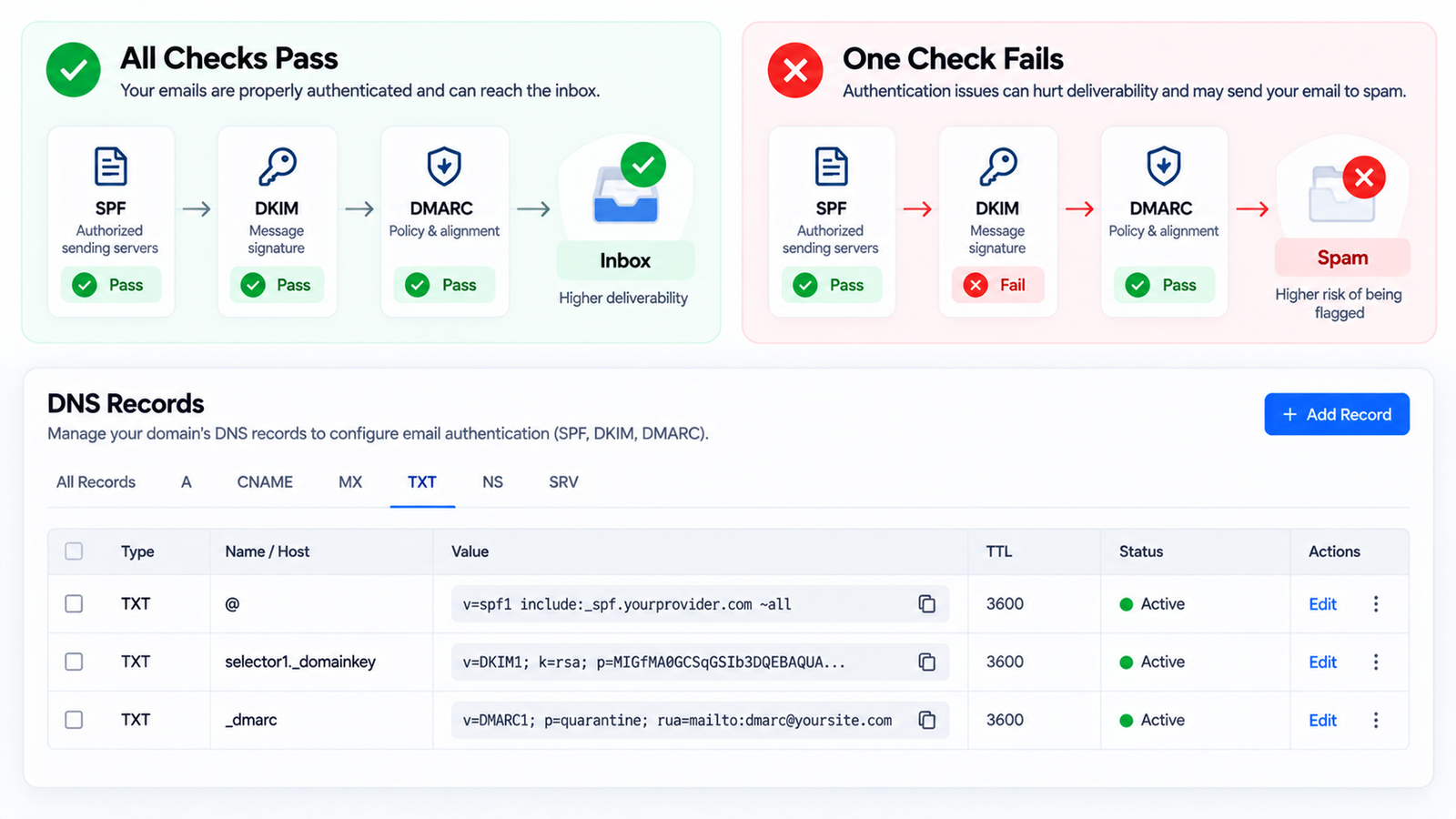
- SPF authorizes which mail servers are allowed to send on a domain's behalf; DKIM cryptographically signs the message so it can't be altered in transit; DMARC tells receiving mail servers what to do when SPF or DKIM fails, and without a DMARC record, inbox providers apply their own default (often stricter) judgment.
- The single most common deliverability mistake when connecting a custom sending domain to GoHighLevel is publishing the DNS records once and never verifying propagation or re-checking them after a domain registrar or DNS host migration.
- A domain with a DMARC policy of `p=reject` or `p=quarantine` set by IT for security reasons, without GoHighLevel's sending infrastructure fully authorized under SPF and DKIM first, will see GoHighLevel-sent email silently fail rather than land anywhere visible.
- Authentication passing is necessary but not sufficient. List hygiene (removing hard bounces and unengaged contacts) and avoiding spam-trigger content still affect inbox placement independently of whether SPF/DKIM/DMARC pass.
- A newly connected sending domain benefits from a gradual volume ramp-up rather than sending full campaign volume on day one, since inbox providers weigh sending reputation that a domain hasn't yet built.
An email that never reaches the inbox doesn’t fail loudly. There’s no bounce, no error message, no obvious signal that anything went wrong: the message simply lands in spam, or gets silently dropped, while the sender assumes it was delivered. In GoHighLevel, this almost always traces back to one thing, the sending domain isn’t properly authenticated with SPF, DKIM and DMARC.
What these three records actually check
Inbox providers (Gmail, Outlook, Yahoo, and the rest) need a way to verify that an email claiming to be from a domain is actually authorized to send on that domain’s behalf. Three separate DNS-based checks handle this, and they check different things.
SPF (Sender Policy Framework) is a DNS TXT record listing which mail servers are allowed to send email for a domain. When a message arrives claiming to be from yourbusiness.com, the receiving server checks whether the server that actually sent it is on the domain’s approved SPF list. If GoHighLevel’s sending infrastructure isn’t included in that list, mail sent through GoHighLevel fails this check.
DKIM (DomainKeys Identified Mail) adds a cryptographic signature to each outgoing message, generated using a private key that matches a public key published in the domain’s DNS. The receiving server verifies the signature against that public key, confirming the message wasn’t altered in transit and genuinely came from a server holding the matching private key, in this case, GoHighLevel’s sending servers, once properly configured.
DMARC (Domain-based Message Authentication, Reporting and Conformance) is a policy layer sitting on top of both, standardized in IETF RFC 7489. It tells receiving servers what to do when a message fails SPF or DKIM: reject it outright, quarantine it (which usually means the spam folder), or take no explicit action while optionally requesting a report on failures. Without a DMARC record at all, receiving servers apply their own default handling, which varies by provider and has gotten stricter as inbox providers tighten spam filtering. Both Google’s and Microsoft’s bulk-sender guidelines now treat all three as baseline requirements, not optional hardening, and Google’s policy specifically requires a DMARC record for anyone sending more than 5,000 messages a day to Gmail addresses.
Why this breaks specifically when connecting GoHighLevel
A domain can have had working email for years, through Google Workspace, Microsoft 365, or a previous marketing platform, and still fail authentication the moment GoHighLevel starts sending on its behalf, because SPF, DKIM and DMARC authorize specific sending sources, not a domain in general. Adding a new sending platform means that platform’s servers need to be explicitly added to the domain’s SPF record and its own DKIM key published, or its outgoing mail will fail authentication even though the domain’s existing email (from Workspace or 365) continues working fine.
This is the single most common cause of “GoHighLevel emails go to spam but our regular company email doesn’t.” The regular email is authenticated under the existing setup; the newly connected GoHighLevel sending domain isn’t yet. It also explains why an SPF record can look “complete” to someone who isn’t checking closely: an SPF record only allows one include: mechanism chain per domain in practice before hitting the 10-lookup limit that RFC 7208 places on SPF evaluation, so a domain that’s already stacked several tools into its SPF record (Workspace, a help desk, a previous marketing platform) can silently fail to add GoHighLevel’s include if that lookup limit is reached, even though the record looks syntactically fine.
Setting it up correctly
GoHighLevel’s domain and email settings provide the exact SPF, DKIM and DMARC record values to publish for a connected sending domain. The actual publishing happens at the domain’s DNS host, wherever the domain is registered or its nameservers point, not inside GoHighLevel itself. In practice:
- Locate the DNS records GoHighLevel specifies for the sending domain (typically a set of TXT and CNAME records).
- Log into the domain’s DNS host (registrar or DNS management provider) and add each record exactly as specified.
- Wait for DNS propagation, which can take anywhere from a few minutes to 24-48 hours depending on the DNS host and existing TTL settings.
- Verify the records are live using GoHighLevel’s own verification indicator or an independent DNS lookup tool, checking that the live records match what was expected.
- Send a low-volume test campaign or transactional email and check inbox placement directly (not just that the send succeeded) before trusting the domain for full campaign volume.
Reading the failure signals
All checks pass, mail lands in spam anyway. Authentication passing is necessary but not sufficient for inbox placement. List hygiene (sending to hard-bounced or long-unengaged addresses) and content that trips spam filters (excessive links, spam-trigger phrasing, mismatched sender name and reply-to) still affect placement independently of authentication status.
One check fails, the others pass. This is often enough to trigger spam placement on its own, particularly a DKIM failure, since a failed signature looks more suspicious to filtering systems than a missing-but-not-actively-failing SPF record. Fix whichever specific record is failing rather than assuming the whole setup needs to be redone.
Everything was working, then suddenly wasn’t. Check for a recent DNS host or domain registrar migration first. Moving a domain’s DNS management, or even switching registrars while keeping the same host, sometimes doesn’t carry over custom TXT records automatically. The second most common cause is an IT team tightening the domain’s DMARC policy (often to p=reject or p=quarantine) for general security reasons without confirming every legitimate sending source, GoHighLevel included, is still properly authorized under the stricter policy.
A brand-new domain, fully authenticated, but still low delivery. A domain with no prior sending history hasn’t yet built sending reputation with inbox providers. Starting at lower volume and ramping up over one to two weeks, while watching bounce and complaint rates, tends to produce better long-term placement than sending at full campaign volume from day one.
A typical two-week reputation warm-up curve for a newly authenticated sending domain: start narrow, watch bounce and complaint rates at each step, and only widen volume once those stay low. This is an illustrative pacing pattern, not a fixed schedule; a domain with any sign of rising complaints at a given stage should hold volume steady rather than advance to the next one.
Where to look first when the inbox stops working
Deliverability problems in GoHighLevel are rarely a platform bug. They’re almost always a DNS authentication gap between the sending domain and GoHighLevel’s sending infrastructure. Confirming SPF, DKIM and DMARC are correctly published and currently live is the first, fastest diagnostic step before assuming anything deeper (list quality, content, sender reputation) is the cause. Getting this right the first time, as part of a proper account setup rather than an afterthought, is part of what’s covered under GoHighLevel implementation services.