
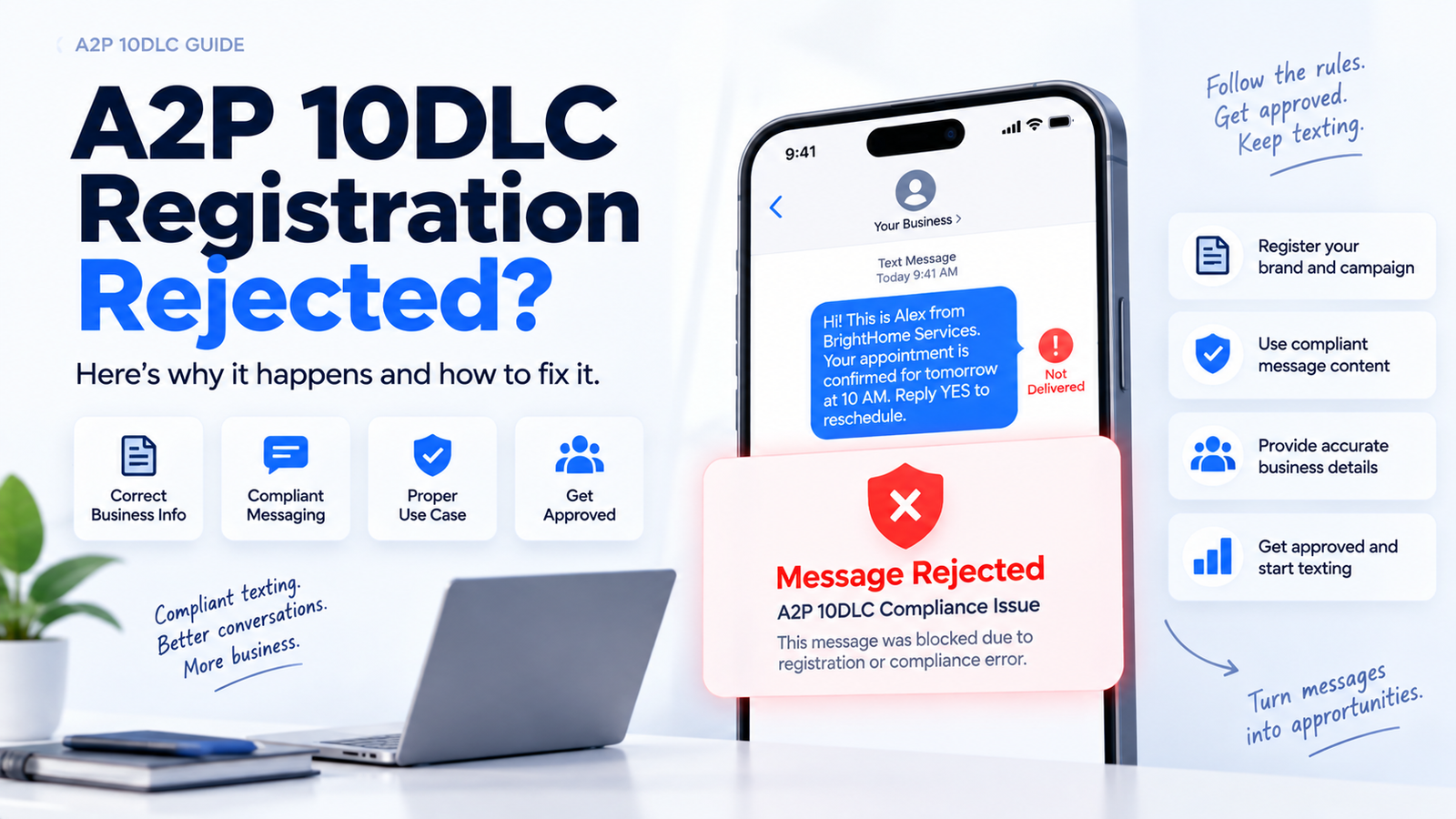
GoHighLevel A2P 10DLC Registration Rejected: Causes and Fixes
Why A2P 10DLC brand or campaign registration gets rejected inside GoHighLevel, the most common reasons, how to correct and resubmit, and what a permanent block actually means.
Key takeaways
- The majority of A2P 10DLC brand rejections trace back to a mismatch between the legal business name, EIN, or address entered in the registration form and what's on file with the government registry the carriers cross-check against — not to anything about the messaging use case itself.
- Campaign rejections are a different failure point from brand rejections, and usually come down to a vague use-case description or sample messages that don't match the selected campaign type's content restrictions.
- 'Rejected' and 'permanently blocked' are not the same status inside The Campaign Registry's system — most rejections are eligible for correction and resubmission, while a permanent block (typically tied to fraud or repeated policy violations) requires registering a new brand entirely.
- Sole proprietors and very new businesses face a structurally higher rejection rate because they often lack the EIN and standardized address records that the registry's verification step relies on, which is a known limitation of the system rather than a GoHighLevel-specific problem.
- Fixing a rejected brand or campaign is a matter of correcting the specific field or content flagged in the rejection reason, not resubmitting the same form again and hoping for a different outcome.
- Carrier-level filtering (messages marked as spam or blocked in transit) is a separate issue from registration rejection, and can still occur even after a campaign is fully approved if message content or sending volume looks non-compliant in practice.
An A2P 10DLC registration rejection inside GoHighLevel almost always comes down to one of a small number of specific, correctable issues: business information that doesn’t match official records, a campaign use-case description that’s too vague for a carrier to classify, sample messages that don’t meet the content requirements for the selected campaign type, or an EIN and legal name pairing that doesn’t verify. None of these require starting over from zero, and none of them mean texting is permanently off the table for the account. What matters is reading the specific rejection reason, understanding which layer (brand or campaign) it applies to, and fixing that exact issue before resubmitting.
This guide breaks down the common rejection reasons, how the fix differs between a brand-level and campaign-level rejection, and what actually distinguishes a correctable rejection from a genuine permanent block. If you’re setting up SMS automation as part of a broader GoHighLevel build, the GoHighLevel implementation services page covers where A2P registration fits into a full setup, and the agency setup guide covers the surrounding automation and workflow layer this registration ultimately unlocks.
Understanding what A2P 10DLC registration actually verifies
A2P 10DLC (Application-to-Person, 10-Digit Long Code) is the registration system U.S. wireless carriers require before a business can send high-volume text messages from a standard local phone number without it being throttled or blocked as suspected spam. The system, operated through The Campaign Registry (TCR), works in two layers: brand registration verifies the business entity sending the messages, and campaign registration verifies the specific use case, message content, and opt-in process for a given messaging program tied to that brand.
GoHighLevel submits this registration on behalf of sub-accounts through its integration with the registry, but the underlying approval or rejection decision comes from TCR and the carriers, not from GoHighLevel itself. That distinction matters for troubleshooting, because it means a rejection reason reflects registry-level or carrier-level policy, and GoHighLevel’s role is largely to pass along that decision and the reason attached to it.
Common reasons brand registration gets rejected
Legal business name or EIN mismatch
The most frequent brand-level rejection happens when the legal business name entered doesn’t exactly match what’s registered with the IRS under the provided EIN, or what’s on file with the state where the business is registered. This includes seemingly minor differences: using “GoHighLevel Agency LLC” when the official filing says “GoHighLevel Agency, LLC,” or omitting a suffix like “Inc.” that appears on the EIN registration. The verification process cross-checks these fields against external data sources, and even small formatting differences can cause a failed match.
The fix is straightforward: pull the exact legal name as it appears on the EIN confirmation letter or state business filing, and enter it into the brand registration form character-for-character, including punctuation and suffixes.
Address mismatch or non-standardized formatting
A registered business address that doesn’t match standard postal formatting, or doesn’t match the address associated with the EIN, can also trigger a rejection. This is especially common for businesses that recently moved, use a registered agent’s address for legal filings but a different address for daily operations, or have inconsistent address formatting across different registrations.
Use the exact address format from official business documentation, and make sure the same address is used consistently if the business has ever changed it in other registrations tied to the same EIN.
Sole proprietor verification limitations
Sole proprietors face a structurally different, and often harder, verification path. Many sole proprietors don’t have a formal EIN and instead operate under a Social Security number, and many don’t have a standardized business address separate from a home address. Because the registry’s verification relies heavily on matching EIN and address records, sole proprietor brands have a thinner verification trail to check against, which results in a meaningfully higher rate of manual review flags and rejections compared to registered LLCs or corporations.
If a sole proprietor registration keeps getting rejected, formalizing the business (obtaining an EIN, even for a sole proprietorship, is possible through the IRS at no cost) often resolves the underlying verification gap rather than repeatedly resubmitting the same thin registration.
Common reasons campaign registration gets rejected
Vague or generic use-case description
Campaign registration requires describing the specific type of messages the business intends to send. A description like “marketing messages” or “business communications” is too generic for a carrier to classify against the standard campaign categories (such as customer care, marketing, account notifications, or two-factor authentication), and vague descriptions are a common source of rejection specifically because the reviewer can’t confirm the described use case matches the selected campaign type.
The fix is specificity: describe who receives the messages, what triggers a message being sent, and what the message contains. “Appointment reminders and rescheduling links sent to clients who booked through our online scheduler” is concrete enough to classify. “Updates to our customers” is not.
Sample messages that don’t match the campaign type or contain non-compliant content
Campaign registration requires submitting sample messages representative of what will actually be sent. Rejections happen when these samples don’t align with the declared use case, contain content restricted for that campaign type (certain categories, like standard messaging campaigns, have specific restrictions on content such as certain financial services, cannabis-related products, or other regulated categories), or are missing required compliance language such as opt-out instructions.
Review the carrier and TCR content guidelines for the selected campaign type before submitting sample messages, and make sure every sample includes the same opt-out and business-identification language that will actually appear in production messages, since inconsistency between samples and real messages is itself a compliance issue that can surface later even after approval.
Missing or inadequate opt-in documentation
Campaigns require a clear, documented opt-in process describing how contacts consented to receive text messages. A campaign submission that doesn’t clearly explain the opt-in mechanism (a checkbox on a form, a keyword text-in process, a verbal consent captured at signup) or that describes a process inconsistent with how the business actually collects consent, can be rejected or flagged for additional review. This requirement exists because carriers hold registered businesses accountable for the accuracy of their consent claims, not because it’s a formality.
Write the opt-in description as if a carrier reviewer has never seen the business’s actual signup form or intake process, because they haven’t. Name the specific mechanism (“a checkbox below the phone number field on our online booking form, which is unchecked by default and reads ‘I agree to receive appointment reminders by text’”) rather than a general statement like “customers opt in when they sign up.” If the business collects consent multiple ways, at booking, over the phone, or through a paper intake form, describe each one, since a reviewer flags a mismatch between the stated process and what a spot-check of the actual form or script reveals more often than a genuinely absent opt-in process.
Rejected versus permanently blocked: what the status actually means
This distinction causes a lot of unnecessary panic. A standard rejection is a correctable status: the registry or carrier identified a specific problem with the submitted information, and once that problem is fixed, the same brand or campaign can typically be resubmitted and re-evaluated. The vast majority of A2P 10DLC rejections fall into this category, and they’re a normal, expected part of the registration process rather than a sign of a serious compliance problem.
A permanent block is a different and much less common status, generally reserved for confirmed fraudulent registration attempts, repeated serious violations of carrier policy, or patterns strongly associated with spam or scam campaigns. A permanent block on a brand typically means that specific brand registration cannot be resubmitted, and starting over requires registering a new brand, which can also require demonstrating that the underlying issue causing the block has been resolved.
If a rejection reason doesn’t explicitly reference fraud, policy violation, or a permanent designation, treat it as a correctable rejection and work through the specific fix rather than assuming the account is done for. Checking the exact rejection reason text in the GoHighLevel A2P 10DLC dashboard, rather than assuming based on the general “rejected” label, is the right first step whenever this happens.
How to fix and resubmit a rejected registration
Start by reading the specific rejection reason provided in GoHighLevel’s A2P 10DLC settings rather than guessing based on the categories above. GoHighLevel surfaces the reason passed back from the registry or carrier, and that reason usually points directly at the field or content that failed review.
For a brand rejection, cross-check every field, legal name, EIN, address, against the exact wording on official business documentation, correct any mismatch, and resubmit. For a campaign rejection, revise the use-case description to be specific and concrete, update sample messages to match both the declared use case and the content restrictions for that campaign type, and confirm the opt-in process description accurately reflects how consent is actually collected. Resubmitting without addressing the specific flagged issue typically produces the same rejection, since the underlying data hasn’t changed.
Once corrections are made, resubmit through the same GoHighLevel A2P 10DLC flow. Processing times vary based on carrier review volume and aren’t controlled by GoHighLevel directly, so checking GoHighLevel’s own help documentation or TCR’s published guidance for current estimates is more reliable than assuming a fixed turnaround.
Approval isn’t the end of compliance monitoring
Getting a brand and campaign approved clears the registration hurdle, but carriers continue monitoring message content, complaint rates, and sending patterns after approval. A campaign that was approved based on a clean use-case description can still see individual messages filtered or throttled later if actual sending behavior drifts from what was registered, sudden volume spikes, message content that looks promotional when the campaign was registered as transactional, or high opt-out and complaint rates.
This is a separate problem from registration rejection and calls for a different fix: reviewing actual message content and list quality against what was registered, rather than resubmitting a registration that’s already approved. Keeping sending behavior consistent with the registered use case is what keeps an approved campaign delivering reliably over time, not just at the moment of approval.
The bottom line on A2P 10DLC rejections in GoHighLevel
Most A2P 10DLC rejections inside GoHighLevel trace back to a specific, identifiable mismatch, business information that doesn’t match official records at the brand level, or a vague use case, non-compliant samples, or unclear opt-in documentation at the campaign level. Reading the exact rejection reason, fixing that specific issue, and resubmitting resolves the large majority of cases. Reserve real concern for the much rarer permanent block status, which is distinct from a standard rejection and generally tied to fraud or repeated policy violations rather than a fixable data mismatch. If SMS automation is central to how an account’s workflows are supposed to run, it’s worth confirming A2P status is fully resolved before troubleshooting related automation issues covered in the workflow triggering guide, since a workflow that depends on SMS sending can appear broken when the real cause is an unresolved registration rejection upstream.